 📸 Photo
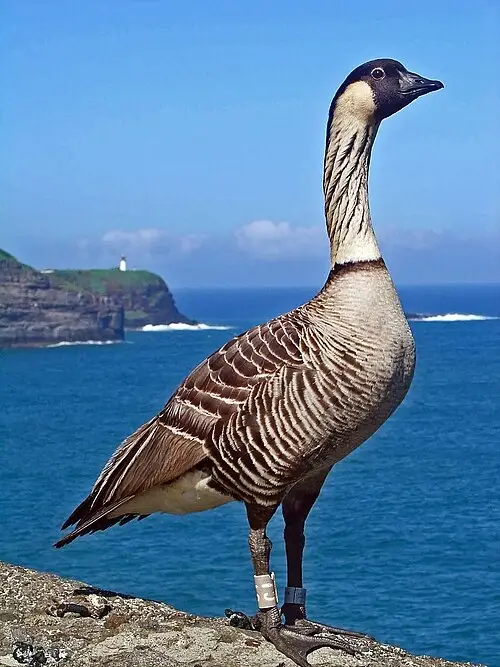
Photo: Brenda Zaun of U.S. Fish and Wildlife Service Headquarters · CC BY 2.0 · Wikimedia Commons Source
Nene
Branta sandvicensis (Nene · ハワイガン)
💡 Everyday Comparisons for Size, Mass & Speed
- 💡 Its maximum mass of 2.3 kg is slightly heavier than one 2 L bottle of water, and its length of 66 cm is about the length of an adult arm (Comparison).
- 💡 As the state bird of Hawaii, it serves as a symbol of Hawaii and an attraction for ecotourism (ADW, 'Economic Importance for Humans: Positive').
Reference standards: coach bus ~12 m, mid-size car ~4.9 m, compact car ~1 t, basketball hoop 3.05 m, credit card 8.56 cm.
Site-computed relative index from recorded values; not a formal scientific metric.
📖 1. Overview
The nene is a goose living on grasslands and volcanic slopes of the Hawaiian Islands and is the state bird of Hawaii. Its long legs and reduced webbing suit walking across lava fields.
🦴 2. Anatomy & Morphology
Its face and crown are black, its cheeks are cream-colored, and its neck is buff with black streaks. Compared with other geese, it has longer legs and less webbing between its toes, helping it walk well over lava. Its wings are 16% smaller than those of its closest relative, the Canada goose, making it a weaker flier, though it can still fly between islands.
🔍 3. Ecology & Behavior
It is an herbivore that forages only on land, eating leaves, grasses, flowers, berries, and seeds, and mainly takes the nutrient-rich lower parts of grasses. It pairs for life, and the immediate family is its closest social unit.
🇰🇷 4. Connection to Korea
No direct record connecting this species to Korea has been found.
📚 Sources & References
- • IUCN Red List NT (2021) — https://www.iucnredlist.org/species/22679929/194369606
- • IUCN Red List category NT — latest assessment at iucnredlist.org
- • doi.org — avilist.v2026
- • iucnredlist.org — 194369606
- • wikidata.org — Q687695
- • commons.wikimedia.org — File:Branta sandvicensis -Kilauea Point National Wildlife Re
- • animaldiversity.org — Branta sandvicensis
- • Silhouette: PhyloPic — Kai Caspar · CC0 1.0
Recorded dimensions are widely cited representative estimates from public literature and may vary by study or specimen.