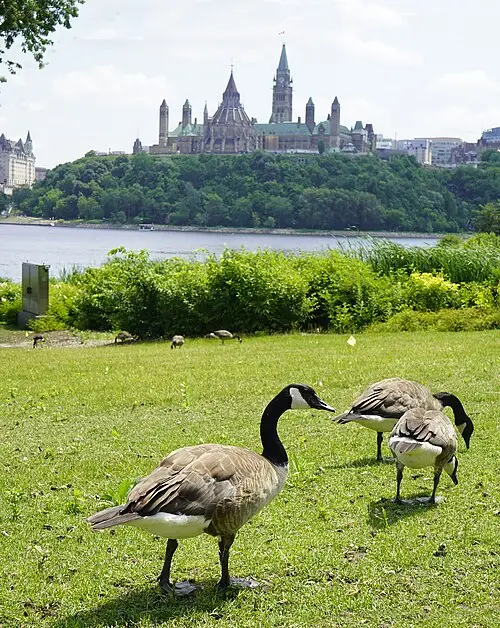
 📸 Photo
Photo: Pierre5018 · CC BY-SA 4.0 · Wikimedia Commons Source
Canada Goose
Branta canadensis (Canada Goose · カナダガン)
💡 Everyday Comparisons for Size, Mass & Speed
- 💡 Its wingspan of 1.7 m is about the height of an adult, and its maximum mass of 10.9 kg is slightly heavier than one 10 kg bag of rice (Comparison).
- 💡 It establishes itself in urban and suburban parks with maintained lawns and can fly up to 2,400 km in a day (ADW).
- 💡 Its down feathers are used in coats, pillows, and blankets, and in some regions it is hunted for meat (ADW, 'Economic Importance for Humans: Positive').
Reference standards: coach bus ~12 m, mid-size car ~4.9 m, compact car ~1 t, basketball hoop 3.05 m, credit card 8.56 cm.
Site-computed relative index from recorded values; not a formal scientific metric.
📖 1. Overview
The Canada goose is a large North American goose marked by a long black head and neck and a white patch near the chin. It adapts so well that it has settled in cities and suburbs with well-kept lawns.
🦴 2. Anatomy & Morphology
It has a long black head and neck with a white mark near the chin, a brownish-grey back, and a cream to white belly and rump. Males are slightly larger than females, though both look similar, and goslings have yellow down with grey-green feathers on the back.
🔍 3. Ecology & Behavior
It is herbivorous, eating leaves, grasses, seeds, berries, algae, and roots, and uses comb-like ridges along the edge of its bill to pull grass. In flight, flocks fly in a V-formation and take turns leading, covering up to 2,400 km in a single day. Pairs stay together for life, and parents with goslings gather into group flocks.
🇰🇷 4. Connection to Korea
No direct record connecting this species to Korea has been found.
📚 Sources & References
- • IUCN Red List LC (2018) — https://www.iucnredlist.org/species/22679935/131909406
- • IUCN Red List category LC — latest assessment at iucnredlist.org
- • doi.org — avilist.v2026
- • iucnredlist.org — 131909406
- • wikidata.org — Q26733
- • commons.wikimedia.org — File:Bernaches du Canada 02.jpg
- • animaldiversity.org — Branta canadensis
- • Silhouette: PhyloPic — Caleb M. Gordon · CC0 1.0
Recorded dimensions are widely cited representative estimates from public literature and may vary by study or specimen.