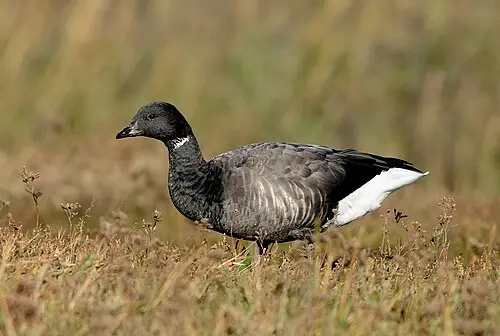
 📸 Photo
Photo: Kev Chapman · CC BY 2.0 · Wikimedia Commons Source
Brant Goose
Branta bernicla (Brant Goose · コクガン)
🇰🇷 Class II endangered wildlife (Korea) · Natural Monument (Korea) «Brant Goose»
💡 Everyday Comparisons for Size, Mass & Speed
- 💡 Because it is a rare and gradually disappearing species among the seven kinds of geese that visit Korea for winter, it is protected as a Natural Monument (Korea) (Korea Heritage Service).
- 💡 Its body length of 66 cm is almost the same as a badminton racket (about 67 cm) (Comparison).
- 💡 Its body mass of 2.2 kg is similar to one 2 L plastic bottle of water (Comparison).
Reference standards: coach bus ~12 m, mid-size car ~4.9 m, compact car ~1 t, basketball hoop 3.05 m, credit card 8.56 cm.
Site-computed relative index from recorded values; not a formal scientific metric.
📖 1. Overview
The brant goose is a small, dark goose that breeds on Arctic coastal tundra and spends the winter along places such as the southern coast of Korea.
🦴 2. Anatomy & Morphology
Its head, breast, and back are black, with a crescent-shaped white mark on the neck and a white belly. Males and females look hard to tell apart.
🔍 3. Ecology & Behavior
In winter it eats aquatic plants such as eelgrass as well as marine algae, and on its breeding grounds it grazes on sedges and grasses. It lays 3–5 eggs per clutch and incubates them for 22–26 days.
🇰🇷 4. Connection to Korea
It is a Class II endangered wildlife (Korea) species and was designated a Natural Monument (Korea) on November 16, 1982 (1982-11-16). It is a rare goose that visits the southern coast of Korea and other areas to spend the winter.
📚 Sources & References
- • IUCN Red List LC (2021) — https://www.iucnredlist.org/species/22679946/189780266
- • 멸종위기 야생생물 Ⅱ급 · 천연기념물 «흑기러기» — 국가생물종목록(국립생물자원관) ktsn 120000001423 — https://species.nibr.go.kr/home/mainHome.do?cont_link=009&subMenu=009002&contCd=009002&ktsn=120000001423
- • IUCN Red List category LC — latest assessment at iucnredlist.org
- • Korean protection status: Class II endangered wildlife (Korea) · Natural Monument (Korea) «Brant Goose»
- • doi.org — avilist.v2026
- • iucnredlist.org — 189780266
- • 국가생물종목록(국립생물자원관) ktsn 120000001423 — https://species.nibr.go.kr/home/mainHome.do?cont_link=009&subMenu=009002&contCd=009002&ktsn=120000001423
- • heritage.go.kr — culSelectDetail.do
- • wikidata.org — Q27050
- • commons.wikimedia.org — File:Branta bernicla bernicla Norfolk 1.jpg
- • heritage.go.kr — cul 1369903250200.html
- • audubon.org — brant
- • species.nibr.go.kr — general-search
- • Silhouette: PhyloPic — Andy Wilson · CC0 1.0 (Congeneric silhouette — Branta hutchinsii)
Recorded dimensions are widely cited representative estimates from public literature and may vary by study or specimen.