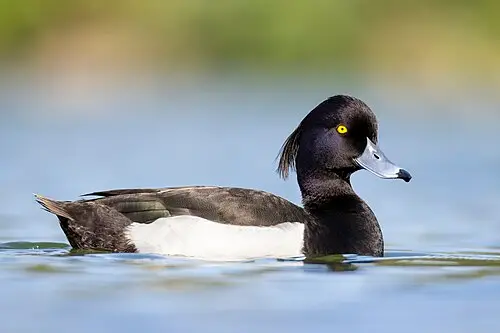
 📸 Photo
Photo: Alexis Lours · CC BY 4.0 · Wikimedia Commons Source
Tufted Duck
Aythya fuligula (Tufted Duck · キンクロハジロ)
💡 Everyday Comparisons for Size, Mass & Speed
- 💡 Its average weight of about 890 g is slightly lighter than a 1 kg bag of sugar, and its length of about 46 cm is roughly the length of an adult human arm.
- 💡 In winter lakes and harbors, it can be watched diving for shrimp, crabs, and clams (National List of Species of Korea, ADW).
- 💡 In regions with hunting seasons, its value as a game bird also provides an incentive for wetland conservation (ADW).
Reference standards: coach bus ~12 m, mid-size car ~4.9 m, compact car ~1 t, basketball hoop 3.05 m, credit card 8.56 cm.
Site-computed relative index from recorded values; not a formal scientific metric.
📖 1. Overview
The Tufted Duck is a medium-sized diving duck characterized by a long drooping crest on the back of the head. It breeds across northern Eurasia and is a common winter visitor to wetlands throughout Korea.
🦴 2. Anatomy & Morphology
Males have a glossy black head with a long nape crest, a black breast and back, and stark white flanks and belly. Females are dark brown overall with a shorter crest, and both sexes have a bluish-grey bill and legs.
🔍 3. Ecology & Behavior
It dives underwater to feed on bivalves (especially zebra mussels), crustaceans such as shrimp and crabs, aquatic insects, and water plants. Forming small flocks in lake estuaries or harbors, several birds dive almost simultaneously and stay submerged for a few seconds to about 1 minute.
🇰🇷 4. Connection to Korea
Listed in the National List of Species of Korea as a common winter visitor observed in wetlands across the country during winter.
📚 Sources & References
- • IUCN Red List LC (2025) — https://www.iucnredlist.org/species/22680391/154567456
- • IUCN Red List category LC — latest assessment at iucnredlist.org
- • doi.org — avilist.v2026
- • iucnredlist.org — 154567456
- • 국가생물종목록(국립생물자원관) ktsn 120000001455 — https://species.nibr.go.kr/home/mainHome.do?cont_link=009&subMenu=009002&contCd=009002&ktsn=120000001455
- • wikidata.org — Q26444
- • commons.wikimedia.org — File:Tufted Duck 09 05 2025 02.jpg
- • animaldiversity.org — Aythya fuligula
- • species.nibr.go.kr — mainHome.do
- • Silhouette: PhyloPic — Gabriela Palomo-Munoz · CC BY 4.0 (Congeneric silhouette — Aythya valisineria)
Recorded dimensions are widely cited representative estimates from public literature and may vary by study or specimen.