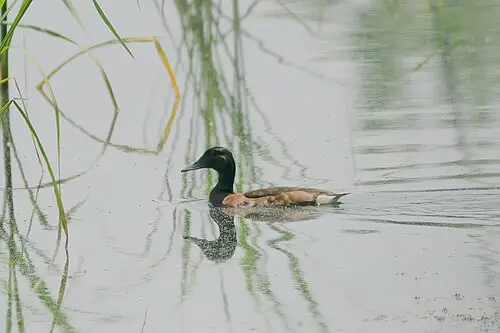
 📸 Photo
Photo: Sun Jiao (Interaccoonale) · CC BY 4.0 · Wikimedia Commons Source
Baer's Pochard
Aythya baeri (Baer's Pochard · アカハジロ)
🇰🇷 Class II endangered wildlife (Korea)
💡 Everyday Comparisons for Size, Mass & Speed
- 💡 As of 2014, 19 zoos worldwide maintained 203 individuals as an assurance population against extinction (CMS Action Plan).
- 💡 Its 47 cm body length is about 1.6 times the long side of an A4 sheet (29.7 cm).
Reference standards: coach bus ~12 m, mid-size car ~4.9 m, compact car ~1 t, basketball hoop 3.05 m, credit card 8.56 cm.
📖 1. Overview
Baer's Pochard is a diving duck that breeds in southeastern Russia and northeastern China and winters in southern China and neighboring regions; it is listed globally as Critically Endangered (CR).
🦴 2. Anatomy & Morphology
Males have a broad body, a rounded head glossed with dark metallic green, a chestnut-brown breast, and a white patch on the fore-flank. Females are duller with a dark brown head.
🔍 3. Ecology & Behavior
It feeds mainly on aquatic plants, though females and ducklings eat mostly insects during the breeding season. It builds a ground nest in waterside reedbeds where the water is less than 1 m deep.
🇰🇷 4. Connection to Korea
In the National List of Species of Korea it is a Class II Endangered Wildlife species, and in the 2012 National Institute of Biological Resources Red List it is listed as Endangered (EN, D1). In Korea, it is recorded on passage or in winter.
📚 Sources & References
- • IUCN Red List CR (2019) — https://www.iucnredlist.org/species/22680384/154436811
- • 멸종위기 야생생물 Ⅱ급 — 국가생물종목록(국립생물자원관) ktsn 120000001453 — https://species.nibr.go.kr/home/mainHome.do?cont_link=009&subMenu=009002&contCd=009002&ktsn=120000001453
- • IUCN Red List category CR — latest assessment at iucnredlist.org
- • Korean protection status: Class II endangered wildlife (Korea)
- • doi.org — avilist.v2026
- • iucnredlist.org — 154436811
- • 국가생물종목록(국립생물자원관) ktsn 120000001453 — https://species.nibr.go.kr/home/mainHome.do?cont_link=009&subMenu=009002&contCd=009002&ktsn=120000001453
- • wikidata.org — Q740680
- • commons.wikimedia.org — File:Aythya baeri female.jpg
- • eaaflyway.net
- • cms.int — baers-pochard-ssap complete 0.pdf
- • species.nibr.go.kr — general-search
- • Silhouette: PhyloPic — Gabriela Palomo-Munoz · CC BY 4.0 (Congeneric silhouette — Aythya valisineria)
Recorded dimensions are widely cited representative estimates from public literature and may vary by study or specimen.