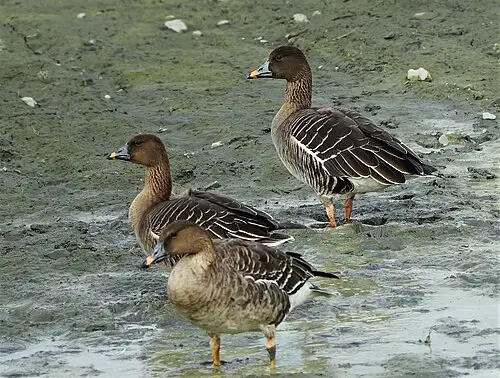
 📸 Photo
Photo: 邱文強 · CC BY-SA 4.0 · Wikimedia Commons Source
Tundra Bean Goose
Anser serrirostris (Tundra Bean Goose · ヒシクイ)
Not Evaluated (NE) on the IUCN Red List yet.
💡 Everyday Comparisons for Size, Mass & Speed
- 💡 Its maximum body length of 89 cm comes up to about an adult's waist (Comparison).
- 💡 In winter it can be seen at migratory bird sites such as the Cheorwon Plain, Sihwaho, Cheonsuman, and Junamjeosuji, eating fallen rice ears in harvested paddies (National Institute of Ecology).
- 💡 Its population is declining due to oil spills and forest development on its breeding grounds, hunting, and pesticide poisoning (National Institute of Ecology).
Reference standards: coach bus ~12 m, mid-size car ~4.9 m, compact car ~1 t, basketball hoop 3.05 m, credit card 8.56 cm.
📖 1. Overview
The Tundra Bean Goose is a large goose that breeds in the tundra and taiga of Eurasia and winters in South Asia, East Asia, and southern and central Europe. In Korea, it can be seen in winter in areas with wide farmlands.
🦴 2. Anatomy & Morphology
Its body length is 76–89 cm, and it is a darker brown than other geese. Its bill is black with a yellow band near the tip, its legs are orange, its upper- and undertail coverts are white, and both sexes have similar plumage.
🔍 3. Ecology & Behavior
Feeding mainly on plant matter, it eats fruits and stems of various plants, and in winter feeds on fallen rice ears in paddies as well as aquatic plants and grass roots. From late May (month 5), it lays 4–6 eggs per clutch and incubates them for 25–29 days.
🇰🇷 4. Connection to Korea
As a winter visitor, it is distributed nationwide in areas with wide farmlands, including major migratory bird sites such as the Cheorwon Plain, Sihwaho, Cheonsuman, and Junamjeosuji.
📚 Sources & References
- • IUCN Red List: not evaluated (NE) — cross-checked with the Wikidata conservation-status entry
- • doi.org — avilist.v2026
- • wikidata.org — Q673280
- • commons.wikimedia.org — File:101777 豆雁來臨.jpg
- • nie.re.kr — view.do
- • Silhouette: PhyloPic — Rebecca Groom · CC BY 3.0 (Congeneric silhouette — Anser indicus)
Recorded dimensions are widely cited representative estimates from public literature and may vary by study or specimen.