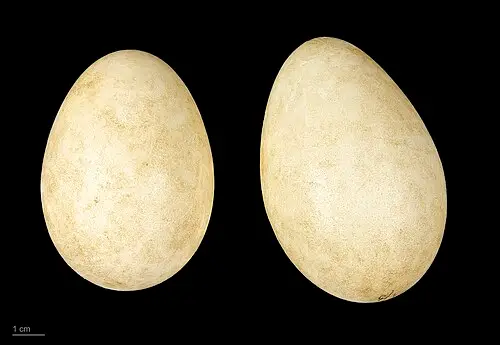
 📸 Photo
Photo: Roger Culos · CC BY-SA 4.0 · Wikimedia Commons Source
Lesser White-fronted Goose
Anser erythropus (Lesser White-fronted Goose · カリガネ)
🇰🇷 Class II endangered wildlife (Korea)
💡 Everyday Comparisons for Size, Mass & Speed
- 💡 Norway restricts access to breeding sites, while Sweden and Finland have carried out reintroduction projects releasing captive-bred birds (Stabbursnes material).
- 💡 Its weight of 2.2 kg is similar to one 2 L plastic bottle of water (Comparison).
Reference standards: coach bus ~12 m, mid-size car ~4.9 m, compact car ~1 t, basketball hoop 3.05 m, credit card 8.56 cm.
Site-computed relative index from recorded values; not a formal scientific metric.
📖 1. Overview
The Lesser White-fronted Goose is a small goose that breeds from northern Europe to Siberia and is globally Vulnerable (VU).
🦴 2. Anatomy & Morphology
Adults have a white forehead, a yellow ring around the eye, and dark barring on the belly. Because the belly pattern differs from bird to bird, individuals can be told apart.
🔍 3. Ecology & Behavior
It is an herbivorous bird that grazes on grass in wet meadows during winter. On its breeding grounds, it nests in birch and willow thickets within wide wetlands.
🇰🇷 4. Connection to Korea
In the National List of Species of Korea, it is listed as Class II endangered wildlife (Korea).
📚 Sources & References
- • IUCN Red List VU (2018) — https://www.iucnredlist.org/species/22679886/132300164
- • 멸종위기 야생생물 Ⅱ급 — 국가생물종목록(국립생물자원관) ktsn 120000001417 — https://species.nibr.go.kr/home/mainHome.do?cont_link=009&subMenu=009002&contCd=009002&ktsn=120000001417
- • IUCN Red List category VU — latest assessment at iucnredlist.org
- • Korean protection status: Class II endangered wildlife (Korea)
- • doi.org — avilist.v2026
- • iucnredlist.org — 132300164
- • 국가생물종목록(국립생물자원관) ktsn 120000001417 — https://species.nibr.go.kr/home/mainHome.do?cont_link=009&subMenu=009002&contCd=009002&ktsn=120000001417
- • wikidata.org — Q191628
- • commons.wikimedia.org — File:Anser erythropus MHNT.ZOO.2010.11.14.6.jpg
- • stabbursnes.no — Dverggas-brosjyre-engelsk.pdf
- • wwf.fi — action-a5-fri-haod-final-deliverable.pdf
- • species.nibr.go.kr — general-search
- • Silhouette: PhyloPic — Rebecca Groom · CC BY 3.0 (Congeneric silhouette — Anser indicus)
Recorded dimensions are widely cited representative estimates from public literature and may vary by study or specimen.