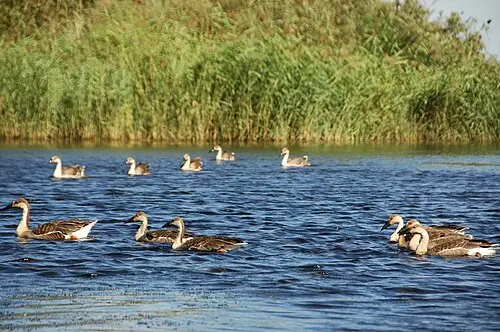
 📸 Photo
Photo: KongFu Wang from Beijing, China · CC BY-SA 2.0 · Wikimedia Commons Source
Swan Goose
Anser cygnoides (Swan Goose · サカツラガン)
🇰🇷 Class II endangered wildlife (Korea) · Natural Monument (Korea) «Swan Goose»
💡 Everyday Comparisons for Size, Mass & Speed
- 💡 Domesticated Swan Geese kept at home also eat rice and grains (ADW).
- 💡 Its average weight of 3.15 kg is similar to one watermelon (around 3 kg) (Comparison).
Reference standards: coach bus ~12 m, mid-size car ~4.9 m, compact car ~1 t, basketball hoop 3.05 m, credit card 8.56 cm.
Site-computed relative index from recorded values; not a formal scientific metric.
📖 1. Overview
The Swan Goose is a large, long-necked goose living in East Asia that visits Korea as a relatively uncommon winter visitor.
🦴 2. Anatomy & Morphology
It has a long neck, dark brown from the lores and crown down the back of the neck, a black bill with a black basal knob, and orange feet. Its breast is grayish brown, while the sides of the neck and lower belly are white.
🔍 3. Ecology & Behavior
It grazes on grasses, roots, seeds, and aquatic plants, and also eats rice, barley, wheat, and bivalves. Beginning to breed in late April to early May (months 4–5), it incubates an average of 5.5 eggs for 28–34 days.
🇰🇷 4. Connection to Korea
It is Class II endangered wildlife (Korea) and was designated as a Natural Monument (Korea) on November 16, 1982 (1982-11-16). Although it once commonly wintered nationwide, it has become very rare in recent years.
📚 Sources & References
- • IUCN Red List EN (2023) — https://www.iucnredlist.org/species/22679869/228564177
- • 멸종위기 야생생물 Ⅱ급 · 천연기념물 «개리» — 국가생물종목록(국립생물자원관) ktsn 120000001413 — https://species.nibr.go.kr/home/mainHome.do?cont_link=009&subMenu=009002&contCd=009002&ktsn=120000001413
- • IUCN Red List category EN — latest assessment at iucnredlist.org
- • Korean protection status: Class II endangered wildlife (Korea) · Natural Monument (Korea) «Swan Goose»
- • doi.org — avilist.v2026
- • iucnredlist.org — 228564177
- • 국가생물종목록(국립생물자원관) ktsn 120000001413 — https://species.nibr.go.kr/home/mainHome.do?cont_link=009&subMenu=009002&contCd=009002&ktsn=120000001413
- • heritage.go.kr — culSelectDetail.do
- • wikidata.org — Q31354
- • commons.wikimedia.org — File:Anser cygnoides Qiqihar 2.jpg
- • animaldiversity.org — Anser cygnoides
- • heritage.go.kr — cul 1369903250100.html
- • species.nibr.go.kr — general-search
- • Silhouette: PhyloPic — Rebecca Groom · CC BY 3.0 (Congeneric silhouette — Anser indicus)
Recorded dimensions are widely cited representative estimates from public literature and may vary by study or specimen.