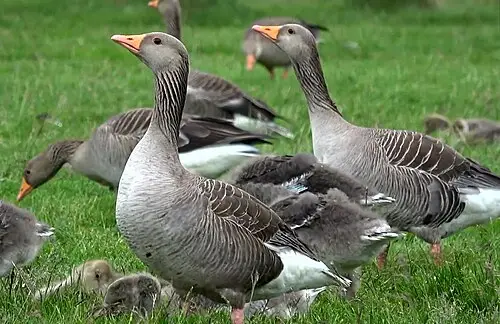
 📸 Photo
Photo: W. Bulach · CC BY-SA 4.0 · Wikimedia Commons Source
Greylag Goose
Anser anser (Greylag Goose · ハイイロガン)
💡 Everyday Comparisons for Size, Mass & Speed
- 💡 Its maximum wingspan of 1.8 m is similar to an adult's height, and its maximum weight of 4.56 kg is less than half of a 10 kg bag of rice (Comparison).
- 💡 Domesticated thousands of years ago for meat and down, its down is used in pillows, comforters, winter clothing, and sleeping bags (ADW, 'Economic Importance for Humans: Positive').
- 💡 It forages in flocks in flooded or dry rice paddies (National List of Species of Korea).
Reference standards: coach bus ~12 m, mid-size car ~4.9 m, compact car ~1 t, basketball hoop 3.05 m, credit card 8.56 cm.
Site-computed relative index from recorded values; not a formal scientific metric.
📖 1. Overview
The Greylag Goose is a large goose breeding in the boreal and subarctic zones of Eurasia and is documented to have been domesticated by humans thousands of years ago. On Jeju Island in Korea, it is a rare vagrant.
🦴 2. Anatomy & Morphology
Its plumage is grayish brown with pale feather edges on the upperparts and a white belly. It has a large orange bill and flesh-pink legs, and its body length is 76–89 cm.
🔍 3. Ecology & Behavior
It eats grasses, rhizomes and roots of marsh plants, spilled grain, and root crops such as turnips, carrots, and potatoes, along with small amounts of tiny aquatic animals. Living in groups ranging from small families to flocks of thousands, it flies in a V-formation on long journeys. Females usually lay 4–6 eggs and incubate them for 27–28 days.
🇰🇷 4. Connection to Korea
In the National List of Species of Korea, it is listed as a vagrant that rarely flies to Jeju Island.
📚 Sources & References
- • IUCN Red List LC (2018) — https://www.iucnredlist.org/species/22679889/131907747
- • IUCN Red List category LC — latest assessment at iucnredlist.org
- • doi.org — avilist.v2026
- • iucnredlist.org — 131907747
- • 국가생물종목록(국립생물자원관) ktsn 120000001415 — https://species.nibr.go.kr/home/mainHome.do?cont_link=009&subMenu=009002&contCd=009002&ktsn=120000001415
- • wikidata.org — Q25882
- • commons.wikimedia.org — File:00 3688 Graugans (Anser anser).jpg
- • animaldiversity.org — Anser anser
- • species.nibr.go.kr — mainHome.do
- • Silhouette: PhyloPic — author not recorded · Public Domain Mark 1.0
Recorded dimensions are widely cited representative estimates from public literature and may vary by study or specimen.