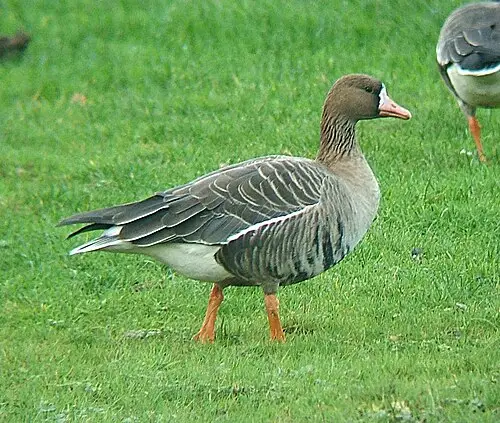
 📸 Photo
Photo: MPF · CC BY-SA 3.0 · Wikimedia Commons Source
Greater White-fronted Goose
Anser albifrons (Greater White-fronted Goose · マガン)
💡 Everyday Comparisons for Size, Mass & Speed
- 💡 Its average weight of 2.72 kg is about 1/4 of a 10 kg bag of rice (Comparison).
- 💡 In winter, it can be seen feeding on fallen grain and rice stubble in harvested rice paddies (National List of Species of Korea).
- 💡 In the United States it is a popular game bird and food source, and fees paid by hunters for hunting stamps help fund wetland conservation (ADW, 'Economic Importance for Humans: Positive').
Reference standards: coach bus ~12 m, mid-size car ~4.9 m, compact car ~1 t, basketball hoop 3.05 m, credit card 8.56 cm.
Site-computed relative index from recorded values; not a formal scientific metric.
📖 1. Overview
The Greater White-fronted Goose breeds in the Arctic regions of Eurasia, North America, and Greenland and gets its name from the white band at the base of its bill. In Korea, it is a common winter visitor that winters in large flocks.
🦴 2. Anatomy & Morphology
Its head is dark brown with white between the eyes and the bill, and its upperparts are grayish brown with white feather edges. Its belly is white, its legs are orange, and its bill is pinkish; males and females have the same plumage color, though males are generally larger.
🔍 3. Ecology & Behavior
It eats grasses, grains, and berries, and in winter feeds on fallen grain, rice stubble, grass blades, stems, and roots. Always moving in flocks and wary by nature, it can form huge winter flocks of up to 30,000 birds. It lays 6–7 eggs per clutch.
🇰🇷 4. Connection to Korea
In the National List of Species of Korea, it is listed as a common winter visitor that forms large flocks on lakes, reservoirs, rivers, coasts, reclaimed wetlands, and farmlands nationwide, mostly mixing with flocks of Tundra Bean Geese.
📚 Sources & References
- • IUCN Red List LC (2022) — https://www.iucnredlist.org/species/22679881/213839615
- • IUCN Red List category LC — latest assessment at iucnredlist.org
- • doi.org — avilist.v2026
- • iucnredlist.org — 213839615
- • 국가생물종목록(국립생물자원관) ktsn 120000001416 — https://species.nibr.go.kr/home/mainHome.do?cont_link=009&subMenu=009002&contCd=009002&ktsn=120000001416
- • wikidata.org — Q172093
- • commons.wikimedia.org — File:Anser albifrons albifrons Swallow Pond 2.jpg
- • animaldiversity.org — Anser albifrons
- • species.nibr.go.kr — mainHome.do
- • Silhouette: PhyloPic — Andy Wilson · CC0 1.0
Recorded dimensions are widely cited representative estimates from public literature and may vary by study or specimen.