 📸 Photo
Photo: jasonkao73 · CC BY-SA 2.0 · Wikimedia Commons Source
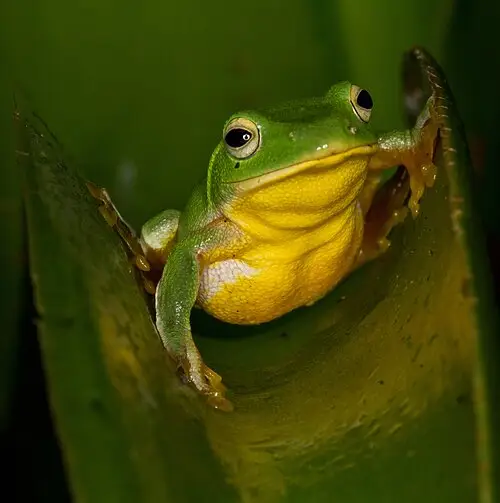
Taipei Treefrog
Zhangixalus taipeianus (Taipei Treefrog · Taipei Treefrog)
💡 Everyday Comparisons for Size, Mass & Speed
- 💡 Its 6 cm body length is a little over twice the diameter of a 500-won coin (26.5 mm) (comparison).
- 💡 A single egg mass holds 300–400 eggs, equivalent to around ten trays of a 30-egg carton (comparison).
- 💡 In mountain regions, the tadpole stage lasts 3 months or longer, so young frogs only emerge in March–April each year.
Reference standards: coach bus ~12 m, mid-size car ~4.9 m, compact car ~1 t, basketball hoop 3.05 m, credit card 8.56 cm.
📖 1. Overview
The Taipei Treefrog (Zhangixalus taipeianus) is a small- to medium-sized treefrog endemic to Taiwan that breeds from late autumn to winter and is protected under Taiwanese law. It is listed as Vulnerable (VU, assessed in 2021) on the IUCN Red List.
🦴 2. Anatomy & Morphology
Measuring 4–6 cm in body length, it has a green back, a yellowish-white belly, and yellow inner thighs mixed with small black spots. The pupil is a horizontal black oval, the iris is yellow, and males have a single vocal sac.
🔍 3. Ecology & Behavior
The breeding season runs from October to March of the following year in mountain areas and from December to February of the following year in lowlands, where males dig burrows in mud by the water and call with low, slow notes. In a 5-year survey on Yangmingshan, individuals lived up to 5 years and returned to the same breeding site every year, with each white foam egg mass containing 300–400 eggs.
🇰🇷 4. Connection to Korea
No direct record connecting this species to Korea has been found.
📚 Sources & References
- • IUCN Red List VU (2021) — https://www.iucnredlist.org/species/59022/63868030
- • IUCN Red List category VU — latest assessment at iucnredlist.org
- • catalogueoflife.org — 5D4MV
- • iucnredlist.org — 63868030
- • wikidata.org — Q112895219
- • commons.wikimedia.org — File:Taipei tree frog - Rhacophorus taipeianus.jpg
- • taieol.tw — 225726
- • Silhouette: PhyloPic — Vijay Karthick · CC0 1.0 (Related taxon silhouette — Raorchestes luteolus)
Recorded dimensions are widely cited representative estimates from public literature and may vary by study or specimen.