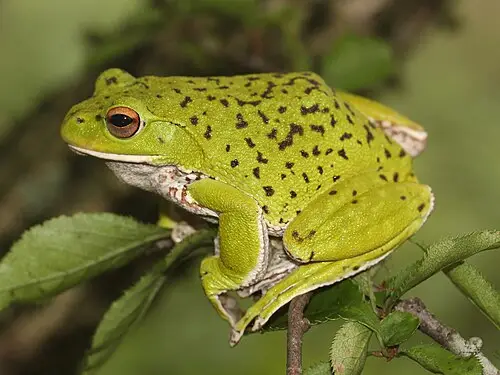
 📸 Photo
Photo: Alpsdake · CC BY-SA 3.0 · Wikimedia Commons Source
Forest Green Tree Frog
Zhangixalus arboreus (Forest Green Tree Frog · モリアオガエル)
💡 Everyday Comparisons for Size, Mass & Speed
- 💡 It hangs white foam masses on waterside branches to lay its eggs, and a single surveyed foam nest contained 377–527 eggs—more than a dozen times a standard tray of eggs (30 eggs) in Korea (Comparison).
- 💡 Tsuruma Pond (780 m elevation) in Yamagata Prefecture, Japan, is the site where this frog spawns in the largest numbers, and the Tohoku Regional Forest Office of the Forestry Agency of Japan manages 61.24 ha there as a habitat protection forest.
Reference standards: coach bus ~12 m, mid-size car ~4.9 m, compact car ~1 t, basketball hoop 3.05 m, credit card 8.56 cm.
📖 1. Overview
The Forest Green Tree Frog (Japanese name Moriaogaeru) is a treefrog endemic to Japan that lives in trees in forests from mountains to lowlands and is famous for hanging white foam nests on branches overhanging water to lay its eggs. It is listed as Least Concern (LC, 2021 assessment) on the IUCN Red List.
🦴 2. Anatomy & Morphology
An arboreal treefrog, during the breeding season the female moves her hind legs to whip up a foam nest on branches above water. No body length or weight figures were found in the official sources consulted.
🔍 3. Ecology & Behavior
It usually builds foam nests on branches overhanging ponds from May to July, with spawning seen in mid- to late June at Tsuruma Pond in Yamagata Prefecture. Experiments have shown that nests built above ground stay warmer inside than outside in cold weather, helping the eggs survive.
🇰🇷 4. Connection to Korea
No direct record connecting this species to Korea has been found.
📚 Sources & References
- • IUCN Red List LC (2021) — https://www.iucnredlist.org/species/58973/177226592
- • IUCN Red List category LC — latest assessment at iucnredlist.org
- • catalogueoflife.org — 5D4LY
- • iucnredlist.org — 177226592
- • wikidata.org — Q106446886
- • commons.wikimedia.org — File:Rhacophorus arboreus 01s.JPG
- • nies.go.jp — 40110e.html
- • rinya.maff.go.jp — turuma.html
- • pmc.ncbi.nlm.nih.gov — PMC10915495
- • pmc.ncbi.nlm.nih.gov — PMC7782537
- • Silhouette: PhyloPic — Vijay Karthick · CC0 1.0 (Related taxon silhouette — Raorchestes luteolus)
Recorded dimensions are widely cited representative estimates from public literature and may vary by study or specimen.