 📸 Photo
Photo: Rushenb · CC BY-SA 4.0 · Wikimedia Commons Source
Wallace's Flying Frog
Rhacophorus nigropalmatus (Wallace's Flying Frog · クロミズカキトビアオガエル)
💡 Everyday Comparisons for Size, Mass & Speed
- 💡 A single glide distance of 50 feet (about 15 m) is just shy of the length of a volleyball court (18 m) (Comparison).
- 💡 The way its webbed hands and feet and lateral skin folds act as sails resembles how a parachute or umbrella catches the air to descend slowly (Comparison).
Reference standards: coach bus ~12 m, mid-size car ~4.9 m, compact car ~1 t, basketball hoop 3.05 m, credit card 8.56 cm.
📖 1. Overview
Wallace's Flying Frog is a 'flying frog' that lives high in the trees of tropical moist forests and glides through the air with its wide-spread webbed feet. It is listed as Least Concern (LC, 2022 assessment) on the IUCN Red List.
🦴 2. Anatomy & Morphology
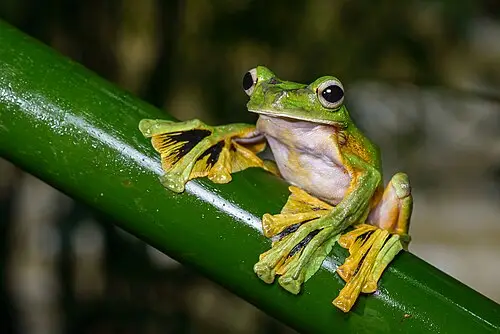
Its body is glossy green with pale yellow on the sides, toe tips, and snout, and it has large eyes. The tips of its fingers and toes expand into pads that cling to vertical surfaces, while its large, fully webbed hands and feet and lateral skin folds catch the air like small sails.
🔍 3. Ecology & Behavior
It feeds on insects and small invertebrates and glides up to 50 feet (about 15 m) between trees. When landing, it makes a long, low approach to slow down and grips the tree with its toe pads; when breeding, the female whips fluid into a foam nest with her hind legs and suspends it over water, and once the eggs become tadpoles the nest breaks apart so they drop into the water.
🇰🇷 4. Connection to Korea
No direct record connecting this species to Korea has been found.
📚 Sources & References
- • IUCN Red List LC (2022) — https://www.iucnredlist.org/species/59008/64129329
- • IUCN Red List category LC — latest assessment at iucnredlist.org
- • catalogueoflife.org — 6X5RD
- • iucnredlist.org — 64129329
- • wikidata.org — Q1190196
- • commons.wikimedia.org — File:Rhacophorus nigropalmatus.jpg
- • animaldiversity.org — Rhacophorus nigropalmatus
- • Silhouette: PhyloPic — author not recorded · Public Domain Mark 1.0 (Congeneric silhouette — Rhacophorus calcadensis)
Recorded dimensions are widely cited representative estimates from public literature and may vary by study or specimen.