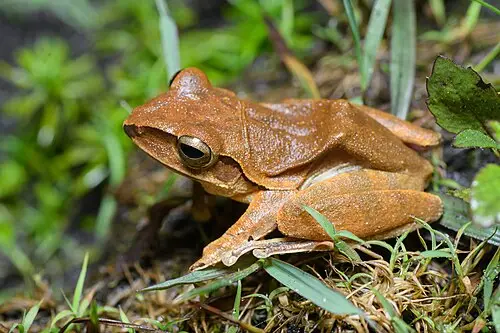
 📸 Photo
Photo: Rushen · CC BY-SA 2.0 · Wikimedia Commons Source
Spot-legged Treefrog
Polypedates megacephalus (Spot-legged Treefrog · Spot-legged Treefrog)
💡 Everyday Comparisons for Size, Mass & Speed
- 💡 The female body length of 8 cm is almost equal to the long side of a credit card (85.6 mm) (Comparison).
- 💡 In Taiwan it spread via eggs and tadpoles mixed in with purchased aquatic plants and flowerpots, expanding enough to appear at 109 of 148 survey sites (about 74%) in 2017 (Taiwan Encyclopedia of Life).
Reference standards: coach bus ~12 m, mid-size car ~4.9 m, compact car ~1 t, basketball hoop 3.05 m, credit card 8.56 cm.
📖 1. Overview
The Spot-legged Treefrog is a medium-sized treefrog widely distributed from central China to northeastern India, living anywhere from forests and fields to pond edges. It is listed as Least Concern (LC, 2022 assessment) on the IUCN Red List and is an invasive alien species in Taiwan.
🦴 2. Anatomy & Morphology
A medium-sized frog with smooth, finely granular skin, its back is gray, yellow, or reddish brown and shifts slightly in color to match its surroundings. It has a triangular head, large eyes, and well-developed adhesive pads on all toes.
🔍 3. Ecology & Behavior
It feeds on ants and various insects and breeds from April to September. In Taiwan, after foam nests and tadpoles were found on aquatic plants purchased in Wuqi, Taichung in 2006, it appears to have spread with potted plants and vegetation, showing up at 109 of 148 survey sites in 2017.
🇰🇷 4. Connection to Korea
No direct record connecting this species to Korea has been found.
📚 Sources & References
- • IUCN Red List LC (2022) — https://www.iucnredlist.org/species/88428054/63882206
- • IUCN Red List category LC — latest assessment at iucnredlist.org
- • catalogueoflife.org — 4LD5C
- • iucnredlist.org — 63882206
- • wikidata.org — Q2716453
- • commons.wikimedia.org — File:Polypedates megacephalus, Spot-legged tree frog - Phu K
- • biosch.hku.hk — Polypedates megacephalus.htm
- • taieol.tw — 72122
- • Silhouette: PhyloPic — author not recorded · CC0 1.0 (Congeneric silhouette — Polypedates)
Recorded dimensions are widely cited representative estimates from public literature and may vary by study or specimen.