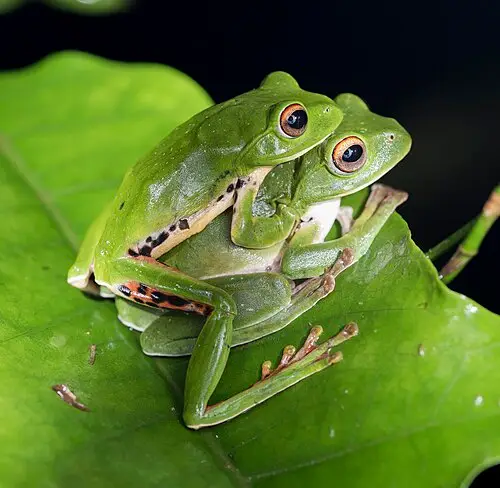
 📸 Photo
Photo: LiCheng Shih · CC BY 2.0 · Wikimedia Commons Source
Moltrecht's Green Treefrog
Zhangixalus moltrechti (Moltrecht's Green Treefrog · Moltrecht's Green Treefrog)
💡 Everyday Comparisons for Size, Mass & Speed
- 💡 Its 6 cm body length is a little over twice the diameter of a 500-won coin (26.5 mm) (comparison).
- 💡 Taiwan's Encyclopedia of Life notes that its habit of stretching out its legs while fleeing to expose its orange inner thighs looks 'as if it is wearing red underwear.'
- 💡 The white foam mass containing the eggs is about 8 cm in diameter, slightly larger than a tennis ball (about 6.7 cm in diameter) (comparison).
Reference standards: coach bus ~12 m, mid-size car ~4.9 m, compact car ~1 t, basketball hoop 3.05 m, credit card 8.56 cm.
📖 1. Overview
Moltrecht's Green Treefrog (Zhangixalus moltrechti) is a medium-sized green treefrog endemic to Taiwan that usually lives in forests and descends to watersides only during the breeding season. It is listed as Least Concern (LC, assessed in 2022) on the IUCN Red List.
🦴 2. Anatomy & Morphology
A green frog about 4–6 cm in body length, developing more black spots on the belly and flanks as it ages. The inner thighs are bright orange to red and the irises of the eyes are also orange-tinted; when fleeing, it stretches its legs to flash the red inner thighs and startle predators.
🔍 3. Ecology & Behavior
The breeding season varies by region: spring and summer in northern and northeastern Taiwan, summer and autumn in central and southern Taiwan, winter around Hualien, and year-round in humid mountains. Males dig shallow burrows under fallen leaves and emit long turkey-like calls, while eggs are laid in white foam masses on plant roots or mud mounds.
🇰🇷 4. Connection to Korea
No direct record connecting this species to Korea has been found.
📚 Sources & References
- • IUCN Red List LC (2022) — https://www.iucnredlist.org/species/59005/63872888
- • IUCN Red List category LC — latest assessment at iucnredlist.org
- • catalogueoflife.org — 5D4MJ
- • iucnredlist.org — 63872888
- • wikidata.org — Q112895214
- • commons.wikimedia.org — File:RBE3364 Zhangixalus moltrechti 莫氏樹蛙.jpg
- • taieol.tw — 225724
- • Silhouette: PhyloPic — Vijay Karthick · CC0 1.0 (Related taxon silhouette — Raorchestes luteolus)
Recorded dimensions are widely cited representative estimates from public literature and may vary by study or specimen.