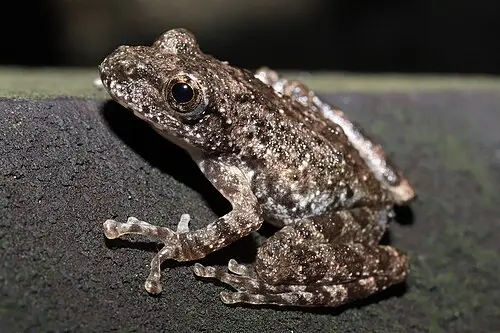
 📸 Photo
Photo: Se Lena · CC BY 4.0 · Wikimedia Commons Source
Kajika Frog
Buergeria buergeri (Kajika Frog · カジカガエル)
💡 Everyday Comparisons for Size, Mass & Speed
- 💡 A body length of 7 cm is slightly shorter than the long side of a credit card (85.6 mm) (Comparison).
- 💡 The 'Yubara Kajika Frog Habitat' at Yubara Onsen in Maniwa City, Okayama Prefecture, was designated a National Natural Monument of Japan on June 26, 1944 (Okayama Prefecture Cultural Properties Commentary).
Reference standards: coach bus ~12 m, mid-size car ~4.9 m, compact car ~1 t, basketball hoop 3.05 m, credit card 8.56 cm.
📖 1. Overview
The Kajika Frog is a small frog endemic to Honshu, Shikoku, and Kyushu in Japan, living in clear mountain streams and renowned for the male's clear mating call. It is listed as Least Concern (LC, assessed in 2021) on the IUCN Red List.
🦴 2. Anatomy & Morphology
It is a small, flattened frog measuring about 4–7 cm in body length. Its grayish-brown body with irregular blotches provides camouflage on rocks.
🔍 3. Ecology & Behavior
Living in mountain streams, it received the Japanese name 'Kajika-gaeru' (river deer frog) because the male's call was likened to the cry of a deer. Due to population declines from habitat destruction, two sites—Yubara Onsen in Maniwa City, Okayama Prefecture, and Iwakuni City in Yamaguchi Prefecture—have been designated as protected habitats.
🇰🇷 4. Connection to Korea
No direct record connecting this species to Korea has been found.
📚 Sources & References
- • IUCN Red List LC (2021) — https://www.iucnredlist.org/species/58782/177227179
- • IUCN Red List category LC — latest assessment at iucnredlist.org
- • catalogueoflife.org — 5WRZM
- • iucnredlist.org — 177227179
- • wikidata.org — Q2274204
- • commons.wikimedia.org — File:Buergeria buergeri from iNaturalist 556444172 (cropped)
- • pref.okayama.jp — 260911.pdf
- • Silhouette: PhyloPic — Vijay Karthick · CC0 1.0 (Related taxon silhouette — Raorchestes luteolus)
Recorded dimensions are widely cited representative estimates from public literature and may vary by study or specimen.