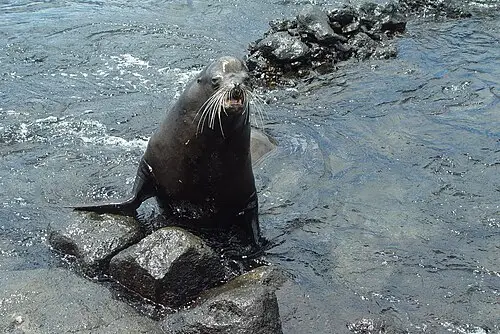
 📸 Photo
Photo: Adavyd · CC BY-SA 4.0 · Wikimedia Commons Source
Galapagos Sea Lion
Zalophus wollebaeki (Galapagos Sea Lion · ガラパゴスアシカ)
💡 Everyday Comparisons for Size, Mass & Speed
- 💡 Its body length of 2.5 m is longer than a single bed (about 2 m) (Comparison).
- 💡 Its weight of 250 kg equals 25 bags of 10 kg rice (Comparison).
- 💡 Because it is endemic to the Galápagos, it draws tourists to the islands (ADW).
Reference standards: coach bus ~12 m, mid-size car ~4.9 m, compact car ~1 t, basketball hoop 3.05 m, credit card 8.56 cm.
Site-computed relative index from recorded values; not a formal scientific metric.
📖 1. Overview
The Galapagos Sea Lion is an endemic species living only on the Galápagos Islands, where females, young, and one dominant male form groups of about 30 individuals. It is also an animal that attracts tourists.
🦴 2. Anatomy & Morphology
A male's fur looks black when wet and dark brown when dry, and fully grown males develop a light gray back. Females, young males, and pups are light brown to tan, while adult males have a thicker neck, shoulders, and chest and a prominent crest on the back of the head.
🔍 3. Ecology & Behavior
It hunts fish, squid, octopuses, and crustaceans in shallow water, smashing octopuses against the water's surface to make them easier to eat. The breeding season is long, lasting from May to January (months 5–1), and after an 11-month gestation a single pup (about 6 kg) is born and weaned at 11–12 months.
🇰🇷 4. Connection to Korea
No direct record connecting this species to Korea has been found.
📚 Sources & References
- • IUCN Red List EN (2026) — https://www.iucnredlist.org/species/41668/281094163
- • IUCN Red List category EN — latest assessment at iucnredlist.org
- • mammaldiversity.org — 1005910
- • iucnredlist.org — 281094163
- • wikidata.org — Q998769
- • commons.wikimedia.org — File:Galápagos sea lion San Cristóbal Galápagos Ecuador DSC0
- • animaldiversity.org — Zalophus wollebaeki
- • Silhouette: PhyloPic — Margot Michaud · CC0 1.0
Recorded dimensions are widely cited representative estimates from public literature and may vary by study or specimen.