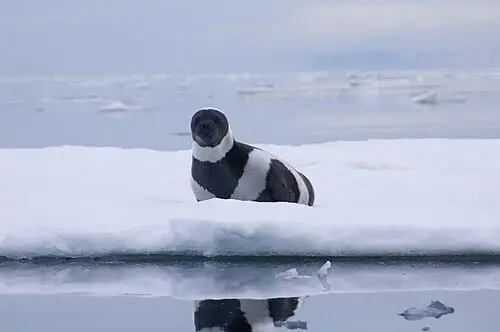
 📸 Photo
Photo: Michael Cameron, NOAA/NMFS/AKFSC/NMML · Public domain · Wikimedia Commons Source
Ribbon Seal
Histriophoca fasciata (Ribbon Seal · クラカケアザラシ)
🇰🇷 Marine Protected Species (Korea)
💡 Everyday Comparisons for Size, Mass & Speed
- 💡 Its body length of 1.6 m is about the average height of a Korean adult (Comparison).
- 💡 Its weight of 95 kg equals 9–10 bags of 10 kg rice (Comparison).
- 💡 In Korea, it is protected as a Marine Protected Species, though records only state that it may migrate into Korean waters in summer (National List of Species of Korea).
Reference standards: coach bus ~12 m, mid-size car ~4.9 m, compact car ~1 t, basketball hoop 3.05 m, credit card 8.56 cm.
Site-computed relative index from recorded values; not a formal scientific metric.
📖 1. Overview
The Ribbon Seal lives in the Bering Sea and the Sea of Okhotsk; adults have white bands around the neck, foreflippers, and hips against a black body. In Korea, it is designated as a Marine Protected Species.
🦴 2. Anatomy & Morphology
Adults have black skin with 4 white rings, which are more distinct in males. Young seals are covered in white fur and develop adult coloration around age 4; the snout is short and the nostrils are wide.
🔍 3. Ecology & Behavior
It dives up to 200 m to catch fish and cephalopods, and is preyed upon by the Great white shark and Common Killer Whale. It lives solitarily without forming herds, giving birth, nursing pups, and molting on sea ice in winter and spring.
🇰🇷 4. Connection to Korea
It is designated as a Marine Protected Species in Korea. The National List of Species of Korea notes its domestic distribution as 'possibly migrating in summer.'
📚 Sources & References
- • IUCN Red List LC (2016) — https://www.iucnredlist.org/species/41670/45230946
- • 해양보호생물 — 국가생물종목록(국립생물자원관) ktsn 120000053321 — https://species.nibr.go.kr/home/mainHome.do?cont_link=009&subMenu=009002&contCd=009002&ktsn=120000053321
- • IUCN Red List category LC — latest assessment at iucnredlist.org
- • Korean protection status: Marine Protected Species (Korea)
- • mammaldiversity.org — 1005914
- • iucnredlist.org — 45230946
- • 국가생물종목록(국립생물자원관) ktsn 120000053321 — https://species.nibr.go.kr/home/mainHome.do?cont_link=009&subMenu=009002&contCd=009002&ktsn=120000053321
- • wikidata.org — Q754895
- • commons.wikimedia.org — File:Male Ribbon Sea Ozernoy Gulf Russia.jpg
- • species.nibr.go.kr — mainHome.do
- • animaldiversity.org — Histriophoca fasciata
- • fisheries.noaa.gov — ribbon-seal
- • Silhouette: PhyloPic — Margot Michaud · CC0 1.0
Recorded dimensions are widely cited representative estimates from public literature and may vary by study or specimen.