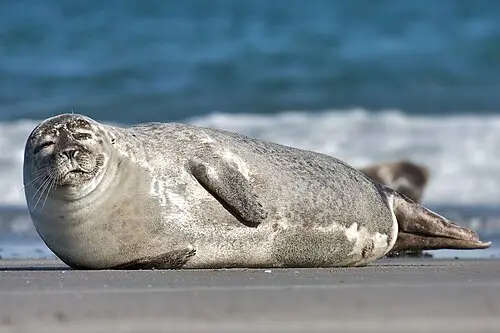
 📸 Photo
Photo: Andreas Trepte · CC BY-SA 2.5 · Wikimedia Commons Source
Harbor Seal
Phoca vitulina (Harbor Seal · ゼニガタアザラシ)
💡 Everyday Comparisons for Size, Mass & Speed
- 💡 Its maximum body length of about 1.8 m is similar to the height of an adult human (Comparison).
- 💡 Its maximum weight of about 129 kg is about thirteen 10 kg bags of rice (Comparison).
- 💡 At the Smithsonian's National Zoo, harbor seals are fed herring, capelin, squid, butterfish, and mackerel (Smithsonian).
Reference standards: coach bus ~12 m, mid-size car ~4.9 m, compact car ~1 t, basketball hoop 3.05 m, credit card 8.56 cm.
Site-computed relative index from recorded values; not a formal scientific metric.
📖 1. Overview
The Harbor Seal is the most widely distributed seal along coastlines of the Northern Hemisphere, spending about half its day resting out of the water on rocks and sandbars.
🦴 2. Anatomy & Morphology
It lacks external ear flaps and has only ear openings, with short flippers for forelimbs. Because its pelvic bones are fused, it cannot walk on its hind flippers like a sea lion and instead wriggles along like a caterpillar.
🔍 3. Ecology & Behavior
It feeds mainly on fish such as cod, herring, mackerel, and salmon, and also eats squid, octopus, and crabs. Dives usually last under 3 minutes, though dives up to 30 minutes and 446 m deep have been recorded. It hauls out to rest, molt, give birth, and nurse its pups.
🇰🇷 4. Connection to Korea
No direct record connecting this species to Korea has been found.
📚 Sources & References
- • IUCN Red List LC (2016) — https://www.iucnredlist.org/species/17013/45229114
- • IUCN Red List category LC — latest assessment at iucnredlist.org
- • mammaldiversity.org — 1005926
- • iucnredlist.org — 45229114
- • wikidata.org — Q26913
- • commons.wikimedia.org — File:Common Seal Phoca vitulina.jpg
- • fisheries.noaa.gov — harbor-seal
- • animaldiversity.org — Phoca vitulina
- • nationalzoo.si.edu — harbor-seal
- • Silhouette: PhyloPic — Andy Wilson · CC0 1.0
Recorded dimensions are widely cited representative estimates from public literature and may vary by study or specimen.