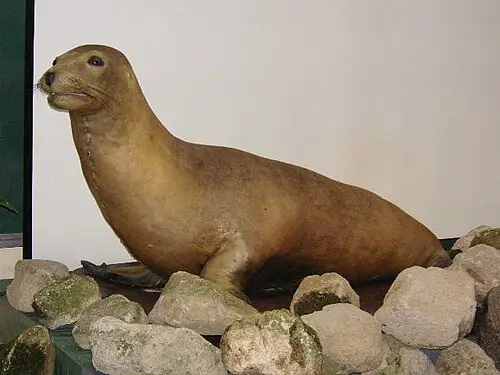
 📸 Photo
Photo: ja:Nkensei · CC BY-SA 3.0 · Wikimedia Commons Source
Japanese Sea Lion
Zalophus japonicus (Japanese Sea Lion · ニホンアシカ)
🇰🇷 Marine Protected Species (Korea)
💡 Everyday Comparisons for Size, Mass & Speed
- 💡 A male's body length of 2.4 m is slightly longer than a single bed (about 2 m) (Comparison).
- 💡 Its weight of 360 kg is about 36 bags of 10 kg rice (Comparison).
- 💡 The National List of Species of Korea records that it lived along the East Sea coast and on Dokdo, and today it is protected as a Marine Protected Species.
Reference standards: coach bus ~12 m, mid-size car ~4.9 m, compact car ~1 t, basketball hoop 3.05 m, credit card 8.56 cm.
Site-computed relative index from recorded values; not a formal scientific metric.
📖 1. Overview
The Japanese Sea Lion is an otariid listed in the National List of Species of Korea as "badasaja" (Korean name) that lived along the East Sea coast and on Dokdo. In its 2017 assessment, the IUCN classifies it as Extinct (EX).
🦴 2. Anatomy & Morphology
Males reached a body length of 190–240 cm and a weight of 360 kg, with short fur and clawed flippers.
🔍 3. Ecology & Behavior
It ate fish, cephalopods, and mollusks. During the breeding season one male gathered a harem of multiple females before dispersing afterward. Mothers carried young pups by the neck in their mouths and plunged into the sea when sensing danger.
🇰🇷 4. Connection to Korea
It is a Marine Protected Species and is listed in the National List of Species of Korea as "badasaja" (Korean name). It is recorded as having inhabited the East Sea coast and Dokdo.
📚 Sources & References
- • IUCN Red List EX (2017) — https://www.iucnredlist.org/species/41667/113089431
- • 해양보호생물 — 국가생물종목록(국립생물자원관) ktsn 120000053316 — https://species.nibr.go.kr/home/mainHome.do?cont_link=009&subMenu=009002&contCd=009002&ktsn=120000053316
- • IUCN Red List category EX — latest assessment at iucnredlist.org
- • Korean protection status: Marine Protected Species (Korea)
- • mammaldiversity.org — 1005909
- • iucnredlist.org — 113089431
- • 국가생물종목록(국립생물자원관) ktsn 120000053316 — https://species.nibr.go.kr/home/mainHome.do?cont_link=009&subMenu=009002&contCd=009002&ktsn=120000053316
- • wikidata.org — Q840036
- • commons.wikimedia.org — File:Zalophus japonicus.JPG
- • species.nibr.go.kr — mainHome.do
- • Silhouette: PhyloPic — Margot Michaud · CC0 1.0
Recorded dimensions are widely cited representative estimates from public literature and may vary by study or specimen.