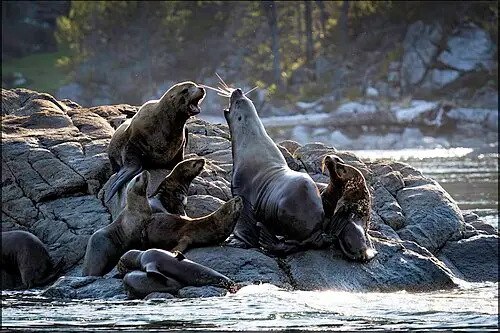
 📸 Photo
Photo: marneejill · CC BY-SA 2.0 · Wikimedia Commons Source
California Sea Lion
Zalophus californianus (California Sea Lion · カリフォルニアアシカ)
💡 Everyday Comparisons for Size, Mass & Speed
- 💡 A male's maximum body length of 2.4 m is longer than a single bed (about 2 m) (Comparison).
- 💡 The U.S. Navy trains this sea lion for search and rescue and for recovering military equipment (ADW).
- 💡 At the Smithsonian's National Zoo, it is fed thawed squid, capelin, herring, butterfish, and mackerel along with separate vitamin supplements (Smithsonian).
Reference standards: coach bus ~12 m, mid-size car ~4.9 m, compact car ~1 t, basketball hoop 3.05 m, credit card 8.56 cm.
Site-computed relative index from recorded values; not a formal scientific metric.
📖 1. Overview
The California Sea Lion is an eared pinniped living along the eastern coast of the North Pacific, commonly seen resting in groups on piers and breakwaters. It lives in colonies, and males defend territories during the breeding season.
🦴 2. Anatomy & Morphology
Its visible ear flaps, swimming with foreflippers, and single-layered coat distinguish it from true seals. Males are dark chestnut brown and develop a prominent forehead crest around age five, while females and young are tan.
🔍 3. Ecology & Behavior
It eats herring, anchovies, rockfish, and squid, diving as deep as 274 m. During the breeding season, males stay to guard their territories for about 2 weeks without even leaving to feed.
🇰🇷 4. Connection to Korea
No direct record connecting this species to Korea has been found.
📚 Sources & References
- • IUCN Red List LC (2026) — https://www.iucnredlist.org/species/41666/294651011
- • IUCN Red List category LC — latest assessment at iucnredlist.org
- • mammaldiversity.org — 1005908
- • iucnredlist.org — 294651011
- • wikidata.org — Q379732
- • commons.wikimedia.org — File:Kalifornischer Seelöwe (Zalophus californianus), Territ
- • animaldiversity.org — Zalophus californianus
- • nationalzoo.si.edu — california-sea-lion
- • fisheries.noaa.gov — california-sea-lion
- • Silhouette: PhyloPic — Margot Michaud · CC0 1.0 (Congeneric silhouette — Zalophus wollebaeki)
Recorded dimensions are widely cited representative estimates from public literature and may vary by study or specimen.