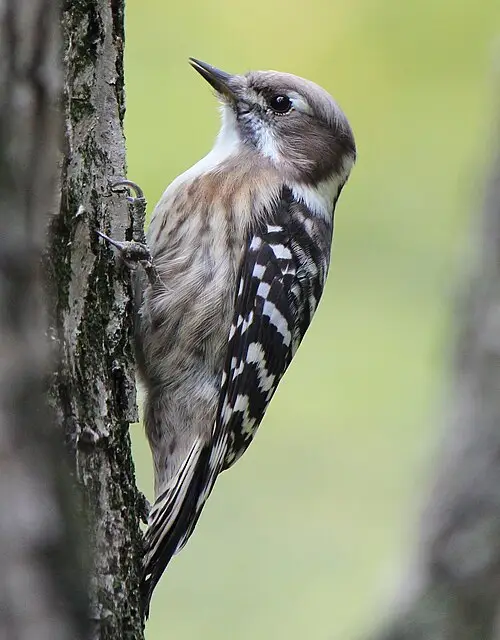
 📸 Photo
Photo: Alpsdake · CC BY-SA 3.0 · Wikimedia Commons Source
Japanese Pygmy Woodpecker
Yungipicus kizuki (Japanese Pygmy Woodpecker · コゲラ)
Not Evaluated (NE) on the IUCN Red List yet.
💡 Everyday Comparisons for Size, Mass & Speed
- 💡 Because it is a common resident bird breeding across Korea, it can be met in nearby broadleaf or mixed woods.
- 💡 In autumn and winter several individuals roam the woods together in flocks, so one can encounter small woodpecker flocks along winter forest trails.
Reference standards: coach bus ~12 m, mid-size car ~4.9 m, compact car ~1 t, basketball hoop 3.05 m, credit card 8.56 cm.
📖 1. Overview
The Japanese Pygmy Woodpecker is a small resident woodpecker that breeds commonly across Korea and also occurs in northeastern China, Ussuri, and Sakhalin.
🦴 2. Anatomy & Morphology
Males have a grayish-brown forehead and crown with small red feather patches on both sides of the back of the head, which females lack. Its tail is black with three black bars on a brownish-white ground near the tips of the outer tail feathers.
🔍 3. Ecology & Behavior
It feeds on insects and plant fruits. It lives alone or in pairs during the breeding season, roams the forest in flocks during autumn and winter, and lays 5–7 eggs per clutch from early May to mid-June.
🇰🇷 4. Connection to Korea
In the National List of Species of Korea, it is listed as a resident bird breeding commonly throughout the Korean Peninsula.
📚 Sources & References
- • IUCN Red List: not evaluated (NE) — cross-checked with the Wikidata conservation-status entry
- • doi.org — avilist.v2026
- • wikidata.org — Q27074882
- • commons.wikimedia.org — File:Dendrocopos kizuki on tree.JPG
- • species.nibr.go.kr — mainHome.do
- • Silhouette: PhyloPic — Pepe Reigada · Public Domain Mark 1.0 (Related taxon silhouette — Jynx torquilla)
Recorded dimensions are widely cited representative estimates from public literature and may vary by study or specimen.