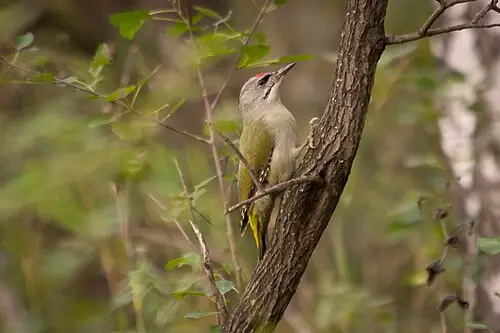
 📸 Photo
Photo: Andrey Tsvirenko · CC BY-SA 3.0 · Wikimedia Commons Source
Grey-headed Woodpecker
Picus canus (Grey-headed Woodpecker · ヤマゲラ)
💡 Everyday Comparisons for Size, Mass & Speed
- 💡 As a resident bird found in forests nationwide, it stands out as it clings vertically to large tree trunks along forest trails and spirals upward.
- 💡 Because it excavates holes and nests in the trunks of tall forest trees, it can be seen in woods with large trees, and it is fond of ants.
Reference standards: coach bus ~12 m, mid-size car ~4.9 m, compact car ~1 t, basketball hoop 3.05 m, credit card 8.56 cm.
📖 1. Overview
The Grey-headed Woodpecker is a woodpecker with a gray head and green back, living as a relatively common resident bird in forests nationwide in Korea.
🦴 2. Anatomy & Morphology
In male winter plumage, the forehead and sides of the head are gray and the crown is glossy red. The back, shoulders, and rump are green with a golden gloss at the tips of the uppertail coverts, while females lack red on the crown and have black vertical streaks.
🔍 3. Ecology & Behavior
Propping its body with its stiff tail feathers, it clings vertically to tree trunks and spirals up toward the top. It feeds mainly on insects and loves ants, excavating holes in large trees to lay 6–8 eggs in April–June.
🇰🇷 4. Connection to Korea
It is listed in the National List of Species of Korea as a relatively common resident bird seen nationwide.
📚 Sources & References
- • IUCN Red List LC (2024) — https://www.iucnredlist.org/species/22726503/264583951
- • IUCN Red List category LC — latest assessment at iucnredlist.org
- • doi.org — avilist.v2026
- • iucnredlist.org — 264583951
- • 국가생물종목록(국립생물자원관) ktsn 120000001918 — https://species.nibr.go.kr/home/mainHome.do?cont_link=009&subMenu=009002&contCd=009002&ktsn=120000001918
- • wikidata.org — Q201106
- • commons.wikimedia.org — File:Седой дятел.jpg
- • species.nibr.go.kr — mainHome.do
- • Silhouette: PhyloPic — Martin Bulla, based on John Cox's illustration · CC BY 4.0 (Congeneric silhouette — Picus viridis)
Recorded dimensions are widely cited representative estimates from public literature and may vary by study or specimen.