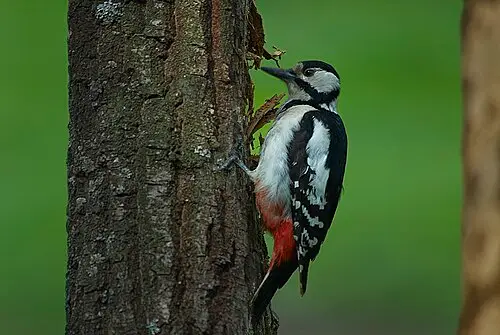
 📸 Photo
Photo: Плешков Алексей · CC BY-SA 3.0 · Wikimedia Commons Source
Great Spotted Woodpecker
Dendrocopos major (Great Spotted Woodpecker · アカゲラ)
💡 Everyday Comparisons for Size, Mass & Speed
- 💡 Its body length of about 24 cm is slightly longer than the short side of an A4 sheet of paper (21 cm) (Comparison).
- 💡 Because it is a common resident found in deciduous broadleaf woods, mixed woods, and subalpine forests nationwide, a tapping sound on a tree trunk along a forest trail is very likely made by this bird.
Reference standards: coach bus ~12 m, mid-size car ~4.9 m, compact car ~1 t, basketball hoop 3.05 m, credit card 8.56 cm.
📖 1. Overview
The great spotted woodpecker is a resident woodpecker commonly seen in forests across Korea, and is also distributed across Europe, Russia, and North America.
🦴 2. Anatomy & Morphology
Its crown and back are glossy bluish-black, and males have a red band about 1 cm wide on the back of the head. The lower belly is rose-colored, the undertail coverts are bright red, and females lack the red band on the back of the head.
🔍 3. Ecology & Behavior
It eats insects, spiders, and plant fruits. It excavates a hole in a tree trunk to lay 4–6 eggs in May–July (months 5–7) and often lives alone or in pairs.
🇰🇷 4. Connection to Korea
It is listed on the National List of Species of Korea as a common resident bird seen nationwide.
📚 Sources & References
- • IUCN Red List LC (2025) — https://www.iucnredlist.org/species/22681124/280946929
- • IUCN Red List category LC — latest assessment at iucnredlist.org
- • doi.org — avilist.v2026
- • iucnredlist.org — 280946929
- • 국가생물종목록(국립생물자원관) ktsn 120000001911 — https://species.nibr.go.kr/home/mainHome.do?cont_link=009&subMenu=009002&contCd=009002&ktsn=120000001911
- • wikidata.org — Q26209
- • commons.wikimedia.org — File:Дятел большой пёстрый KR 01.jpg
- • species.nibr.go.kr — mainHome.do
- • Silhouette: PhyloPic — Steven Traver · CC0 1.0
Recorded dimensions are widely cited representative estimates from public literature and may vary by study or specimen.