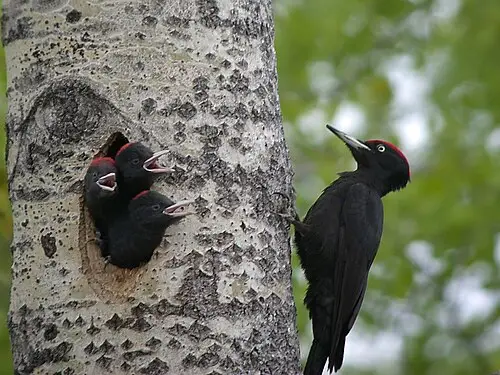
 📸 Photo
Photo: Alastair Rae from London, United Kingdom · CC BY-SA 2.0 · Wikimedia Commons Source
Black Woodpecker
Dryocopus martius (Black Woodpecker · クマゲラ)
🇰🇷 Class II endangered wildlife (Korea) · Natural Monument (Korea) «Black Woodpecker»
💡 Everyday Comparisons for Size, Mass & Speed
- 💡 The dull thud of its pecking on trees is said to echo through the mountains loudly enough to reveal its location by sound alone (Encyclopedia of Korean Culture).
- 💡 Its body length of about 46 cm is around 1.5 times the long side of an A4 sheet of paper (29.7 cm) (Comparison).
Reference standards: coach bus ~12 m, mid-size car ~4.9 m, compact car ~1 t, basketball hoop 3.05 m, credit card 8.56 cm.
Site-computed relative index from recorded values; not a formal scientific metric.
📖 1. Overview
The black woodpecker is a large all-black woodpecker about 46 cm long that lives in boreal and temperate forests of Europe and Asia. In Korea, it was once common in forests of the central and northern regions, but logging has reduced it to a very rare resident bird today.
🦴 2. Anatomy & Morphology
Males have a red crown, while females have red only on the back of the head. Its bill is triangular and pointed, greyish-white with a black tip.
🔍 3. Ecology & Behavior
It favors adult beetles and beetle larvae, also eats ants and flies, and occasionally takes fruit. It lays 3–5 eggs in April–June (months 4–6) and incubates them for 14–16 days.
🇰🇷 4. Connection to Korea
It is a Class II endangered wildlife (Korea) species and was designated a Natural Monument (Korea) on April 12, 1973 (1973-04-12). Breeding was confirmed at Beopheungsa Temple in Yeongwol in 1989 and at Songnisan Mountain in 1991.
📚 Sources & References
- • IUCN Red List LC (2024) — https://www.iucnredlist.org/species/22681382/264542554
- • 멸종위기 야생생물 Ⅱ급 · 천연기념물 «까막딱따구리» — 국가생물종목록(국립생물자원관) ktsn 120000001916 — https://species.nibr.go.kr/home/mainHome.do?cont_link=009&subMenu=009002&contCd=009002&ktsn=120000001916
- • IUCN Red List category LC — latest assessment at iucnredlist.org
- • Korean protection status: Class II endangered wildlife (Korea) · Natural Monument (Korea) «Black Woodpecker»
- • doi.org — avilist.v2026
- • iucnredlist.org — 264542554
- • 국가생물종목록(국립생물자원관) ktsn 120000001916 — https://species.nibr.go.kr/home/mainHome.do?cont_link=009&subMenu=009002&contCd=009002&ktsn=120000001916
- • heritage.go.kr — culSelectDetail.do
- • wikidata.org — Q143284
- • commons.wikimedia.org — File:BlackWoods.jpg
- • genomics.senescence.info — entry.php
- • encykorea.aks.ac.kr — E0011210
- • Silhouette: PhyloPic — Walter Imp · Public Domain Mark 1.0
Recorded dimensions are widely cited representative estimates from public literature and may vary by study or specimen.