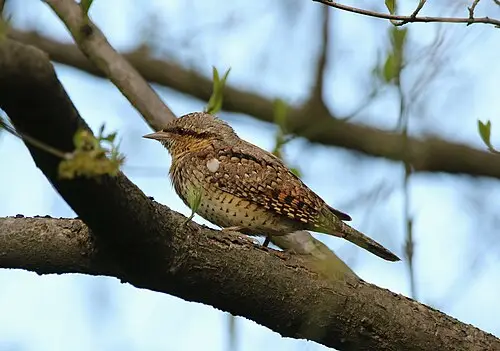
 📸 Photo
Photo: Donald Hobern from Copenhagen, Denmark · CC BY 2.0 · Wikimedia Commons Source
Eurasian Wryneck
Jynx torquilla (Eurasian Wryneck · アリスイ)
💡 Everyday Comparisons for Size, Mass & Speed
- 💡 In Korea, it is hard to encounter because it only passes through very rarely outside the Baekdusan region. Its Korean name "Gaemi-jabi" (meaning ant-catcher) comes from its fondness for eating ants.
- 💡 It lives in shrublands or trees near villages and lays its eggs in tree cavities.
Reference standards: coach bus ~12 m, mid-size car ~4.9 m, compact car ~1 t, basketball hoop 3.05 m, credit card 8.56 cm.
📖 1. Overview
The Eurasian Wryneck is a bird in the woodpecker family that, as its Korean name suggests, loves eating ants; in Korea, it is a summer visitor in the Baekdusan region and a very rare passage migrant elsewhere.
🦴 2. Anatomy & Morphology
Its upperparts are gray patterned with brown and a black central stripe, while its underparts are white. Its tail is yellowish-gray with brown markings and 5–6 black horizontal bars, and its legs are pale brown.
🔍 3. Ecology & Behavior
It mainly eats insects such as beetles, wasps, bees, and butterflies along with spiders, and especially favors ants. In June–July, it lays 6–10 white eggs in tree cavities or old woodpecker nests.
🇰🇷 4. Connection to Korea
In the National List of Species of Korea, it is listed as a summer visitor in the Baekdusan region and a very rare passage migrant elsewhere, arriving in April–May and staying until September.
📚 Sources & References
- • IUCN Red List LC (2025) — https://www.iucnredlist.org/species/22680683/157474468
- • IUCN Red List category LC — latest assessment at iucnredlist.org
- • doi.org — avilist.v2026
- • iucnredlist.org — 157474468
- • 국가생물종목록(국립생물자원관) ktsn 120000001903 — https://species.nibr.go.kr/home/mainHome.do?cont_link=009&subMenu=009002&contCd=009002&ktsn=120000001903
- • wikidata.org — Q25678
- • commons.wikimedia.org — File:Jynx torquilla (34536504885).jpg
- • species.nibr.go.kr — mainHome.do
- • Silhouette: PhyloPic — Pepe Reigada · Public Domain Mark 1.0
Recorded dimensions are widely cited representative estimates from public literature and may vary by study or specimen.