 📸 Photo
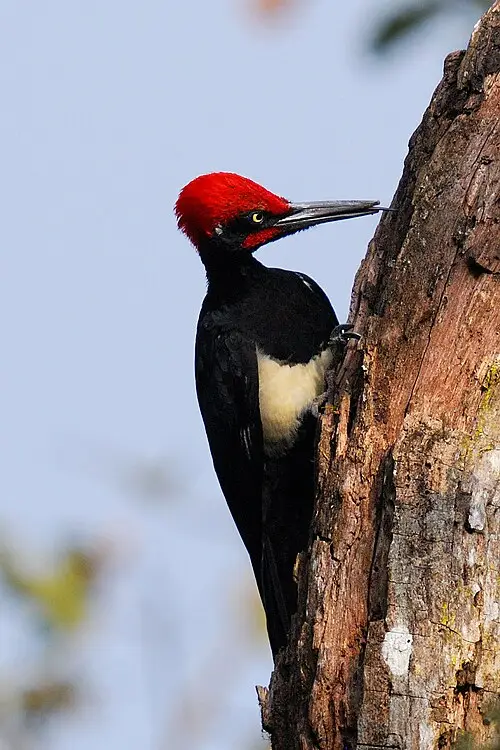
Photo: Sriniketana · CC BY 3.0 · Wikimedia Commons Source
White-bellied Woodpecker
Dryocopus javensis (White-bellied Woodpecker · キタタキ)
🇰🇷 Class I endangered wildlife (Korea) · Natural Monument (Korea) «White-bellied Woodpecker»
💡 Everyday Comparisons for Size, Mass & Speed
- 💡 In North Korea, it is called Keullaksae (Korean name) after its 'keullak keullak' call (Korea Heritage Service).
- 💡 Its body length of about 46 cm is slightly taller than two 500 mL plastic bottles (about 20 cm each) stacked end to end (Comparison).
Reference standards: coach bus ~12 m, mid-size car ~4.9 m, compact car ~1 t, basketball hoop 3.05 m, credit card 8.56 cm.
📖 1. Overview
The white-bellied woodpecker is a large woodpecker about 46 cm long with a white belly and glossy black plumage elsewhere. In Korea, Gwangneung Forest was known as its breeding site, but with no confirmed records since 1993 it is considered extirpated in the country.
🦴 2. Anatomy & Morphology
Males have a red crown and cheek patch beside the bill, whereas these are black in females. Its bill is greenish-yellow with a black tip.
🔍 3. Ecology & Behavior
It nests in holes it excavates in old trees or in natural cavities, laying 2–4 eggs in April–May (months 4–5), and the male incubates longer than the female. Chicks are fed mainly beetle larvae and ants, and in autumn adults also eat tree fruits.
🇰🇷 4. Connection to Korea
It is a Class I endangered wildlife (Korea) species and was designated a Natural Monument (Korea) on May 31, 1968 (1968-05-31). Its Gwangneung Forest breeding area was separately designated on December 7, 1962 (1962-12-07), but there have been no confirmed records since 1993.
📚 Sources & References
- • IUCN Red List LC (2025) — https://www.iucnredlist.org/species/22681376/275512522
- • 멸종위기 야생생물 Ⅰ급 · 천연기념물 «크낙새» — 국가생물종목록(국립생물자원관) ktsn 120000001915 — https://species.nibr.go.kr/home/mainHome.do?cont_link=009&subMenu=009002&contCd=009002&ktsn=120000001915
- • IUCN Red List category LC — latest assessment at iucnredlist.org
- • Korean protection status: Class I endangered wildlife (Korea) · Natural Monument (Korea) «White-bellied Woodpecker»
- • doi.org — avilist.v2026
- • iucnredlist.org — 275512522
- • 국가생물종목록(국립생물자원관) ktsn 120000001915 — https://species.nibr.go.kr/home/mainHome.do?cont_link=009&subMenu=009002&contCd=009002&ktsn=120000001915
- • heritage.go.kr — culSelectDetail.do
- • wikidata.org — Q495520
- • commons.wikimedia.org — File:WhiteBelliedWoodpecker.JPG
- • encykorea.aks.ac.kr — E0058670
- • Silhouette: PhyloPic — Ferran Sayol · CC0 1.0 (Congeneric silhouette — Dryocopus)
Recorded dimensions are widely cited representative estimates from public literature and may vary by study or specimen.