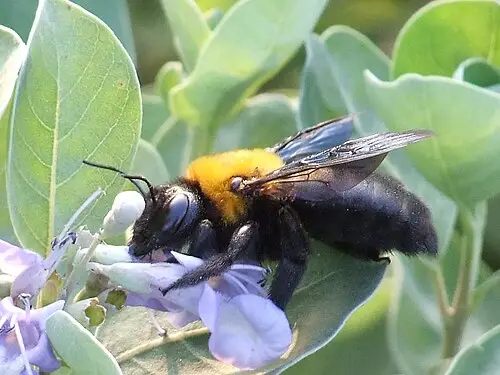
 📸 Photo
Photo: No machine-readable author provided. Commonsenses~commonswiki assumed (based on copyright claims). · CC BY 2.5 · Wikimedia Commons Source
Appendiculate carpenter bee
Xylocopa appendiculata (Appendiculate carpenter bee · Appendiculate carpenter bee)
Not Evaluated (NE) on the IUCN Red List yet.
💡 Everyday Comparisons for Size, Mass & Speed
- 💡 A length of 2.5 cm is slightly smaller than the diameter of a Korean 500-won coin (2.65 cm) (Comparison).
- 💡 Japanese researchers collected venom from 15 females to analyze its components, noting that collection was difficult due to its solitary lifestyle (Kawakami et al. 2017).
Reference standards: coach bus ~12 m, mid-size car ~4.9 m, compact car ~1 t, basketball hoop 3.05 m, credit card 8.56 cm.
📖 1. Overview
The appendiculate carpenter bee is a solitary carpenter bee (Xylocopa) whose venom components were studied in Japan, where it has been called the 'Japanese carpenter bee.' It is also listed in the National List of Species of Korea.
🦴 2. Anatomy & Morphology
Adults are about 20–25 mm long. Its venom sac is smaller than those of honey bees and hornets, yielding less venom, and its venom—composed of biogenic amines, amphipathic peptides, and PLA2—is similar to that of honey bees and bumblebees.
🔍 3. Ecology & Behavior
Because it lives solitarily, it is difficult to collect. The venom of some other carpenter bee species is lethal to small birds and mice, and some species are reported to have a sting as painful to humans as a honey bee sting.
🇰🇷 4. Connection to Korea
It is listed as 'Eorihobakbeol' (Korean name) in the National List of Species of Korea.
📚 Sources & References
- • IUCN Red List: not evaluated (NE) — cross-checked with the Wikidata conservation-status entry
- • catalogueoflife.org — 5CKPB
- • 국가생물종목록(국립생물자원관) ktsn 120000027513 — https://species.nibr.go.kr/home/mainHome.do?cont_link=009&subMenu=009002&contCd=009002&ktsn=120000027513
- • wikidata.org — Q8007085
- • commons.wikimedia.org — File:Kumabachi1.jpg
- • ncbi.nlm.nih.gov — PMC5442655
- • Silhouette: PhyloPic — Markus Bautsch · Public Domain Mark 1.0 (Congeneric silhouette — Xylocopa violacea)
Recorded dimensions are widely cited representative estimates from public literature and may vary by study or specimen.