 📸 Photo
Photo: Original uploader was Bksimonb at en.wikipedia · CC BY-SA 3.0 · Wikimedia Commons Source
Giant honey bee
Apis dorsata (Giant honey bee · オオミツバチ)
Not Evaluated (NE) on the IUCN Red List yet.
💡 Everyday Comparisons for Size, Mass & Speed
- 💡 A worker's length of 3 cm is slightly longer than the diameter of a Korean 500-won coin (2.65 cm) (Comparison).
- 💡 Specialist honey hunters harvest honey seasonally from combs high in trees or on cliffs (UF/IFAS).
Reference standards: coach bus ~12 m, mid-size car ~4.9 m, compact car ~1 t, basketball hoop 3.05 m, credit card 8.56 cm.
📖 1. Overview
The giant honey bee is a giant bee living across South Asia that hangs a single large, exposed comb beneath thick tree branches or cliffs rather than inside tree cavities. It is not recorded on the National List of Species of Korea.
🦴 2. Anatomy & Morphology
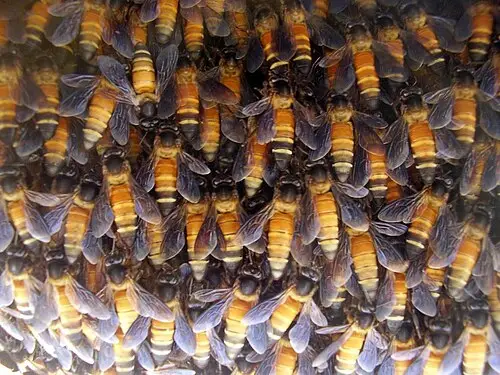
Workers reach up to 3 cm in body length, nearly twice the size of western honey bee workers, and there is little size difference between queens, drones, and workers. Its stinger is up to 3 mm long and can pierce clothing and even bear fur.
🔍 3. Ecology & Behavior
A colony consists of one queen, a few drones, and thousands of workers. The comb grows up to 150 cm long and 70 cm tall, covered and defended in layers by up to 100,000 workers. Colonies migrate long distances seasonally and perform a wave-like "shimmering" defense by raising their abdomens when threatened.
🇰🇷 4. Connection to Korea
No direct record connecting this species to Korea has been found.
📚 Sources & References
- • IUCN Red List: not evaluated (NE) — cross-checked with the Wikidata conservation-status entry
- • catalogueoflife.org — FMZF
- • wikidata.org — Q840434
- • commons.wikimedia.org — File:ApisDorsataHive.jpg
- • edis.ifas.ufl.edu — IN1119
- • Silhouette: PhyloPic — Melissa Broussard · CC BY 3.0 (Congeneric silhouette — Apis florea)
Recorded dimensions are widely cited representative estimates from public literature and may vary by study or specimen.