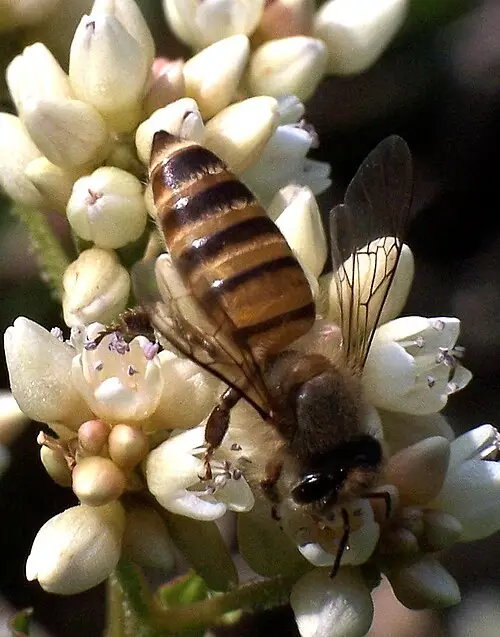
 📸 Photo
Photo: Charles Lam · CC BY-SA 2.0 · Wikimedia Commons Source
Asian honey bee
Apis cerana (Asian honey bee · トウヨウミツバチ)
Not Evaluated (NE) on the IUCN Red List yet.
💡 Everyday Comparisons for Size, Mass & Speed
- 💡 Its body length of 12 mm is less than half the diameter of a Korean 500-won coin (26.5 mm) (Comparison).
- 💡 It can be seen in mountains and meadows anywhere in Korea and is hardier against the cold than the western honey bee (National List of Species of Korea).
Reference standards: coach bus ~12 m, mid-size car ~4.9 m, compact car ~1 t, basketball hoop 3.05 m, credit card 8.56 cm.
📖 1. Overview
The Asian honey bee is a honey bee species living throughout the Korean Peninsula and is also distributed in Japan, China, and Southeast Asia. Compared to the western honey bee, it is more resistant to cold.
🦴 2. Anatomy & Morphology
Its body length is 12 mm, and its entire body is evenly covered with yellow hairs. Its compound eyes are black with thick yellow hairs densely packed between them. The abdomen is black with yellow hairs between segments, and the legs are black with increasingly more yellow hairs toward the tips.
🔍 3. Ecology & Behavior
It builds vertical combs inside dead trees, rock crevices, and caves in mountains and grasslands.
🇰🇷 4. Connection to Korea
It inhabits the entire Korean Peninsula (National List of Species of Korea).
📚 Sources & References
- • IUCN Red List: not evaluated (NE) — cross-checked with the Wikidata conservation-status entry
- • catalogueoflife.org — FMYD
- • 국가생물종목록(국립생물자원관) ktsn 120000027385 — https://species.nibr.go.kr/home/mainHome.do?cont_link=009&subMenu=009002&contCd=009002&ktsn=120000027385
- • wikidata.org — Q306939
- • commons.wikimedia.org — File:Cerana.jpg
- • species.nibr.go.kr — mainHome.do
- • Silhouette: PhyloPic — Melissa Broussard · CC BY 3.0 (Congeneric silhouette — Apis florea)
Recorded dimensions are widely cited representative estimates from public literature and may vary by study or specimen.