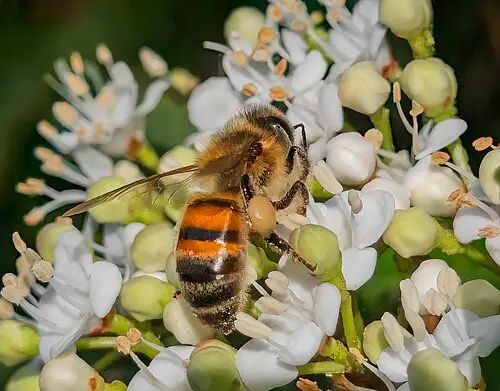
 📸 Photo
Photo: Didier Descouens · CC BY-SA 4.0 · Wikimedia Commons Source
Western honey bee
Apis mellifera (Western honey bee · セイヨウミツバチ)
💡 Everyday Comparisons for Size, Mass & Speed
- 💡 A worker bee of about 1.2 cm is less than half the diameter of a Korean 500-won coin (2.65 cm) (Comparison).
- 💡 Honey, beeswax, pollen, propolis, and royal jelly harvested from hives are sold for medicines and cosmetics, and honey bees pollinate billions of dollars' worth of crops worldwide every year (ADW).
Reference standards: coach bus ~12 m, mid-size car ~4.9 m, compact car ~1 t, basketball hoop 3.05 m, credit card 8.56 cm.
📖 1. Overview
The western honey bee is a social honey bee used in beekeeping by humans and distributed worldwide. Each colony has a single reproductive queen and sterile female workers that handle the colony's tasks.
🦴 2. Anatomy & Morphology
Its body is covered with long grayish-yellow hairs, and its hind legs have pollen baskets for carrying pollen. Workers measure 10–15 mm and queens 18–20 mm, and a worker's stinger is barbed so it tears away from the body when stinging.
🔍 3. Ecology & Behavior
It feeds on pollen, nectar, and stored honey, with workers foraging for the entire colony. Workers change roles as they age, moving from cleaning cells to tending the hive to foraging. Mating takes place in midair at drone congregation areas.
🇰🇷 4. Connection to Korea
The National List of Species of Korea lists its domestic distribution as nationwide. Its breeding season is from April to June, and after mid-October colonies gather and move to overwintering sites.
📚 Sources & References
- • IUCN Red List category DD — latest assessment at iucnredlist.org
- • catalogueoflife.org — FN46
- • iucnredlist.org — 42463639
- • 국가생물종목록(국립생물자원관) ktsn 120000027386 — https://species.nibr.go.kr/home/mainHome.do?cont_link=009&subMenu=009002&contCd=009002&ktsn=120000027386
- • wikidata.org — Q30034
- • commons.wikimedia.org — File:(MHNT) Apis mellifera (female) - on viburnum tinus flow
- • animaldiversity.org — Apis mellifera
- • species.nibr.go.kr — mainHome.do
- • Silhouette: PhyloPic — Melissa Broussard · CC BY 4.0
Recorded dimensions are widely cited representative estimates from public literature and may vary by study or specimen.