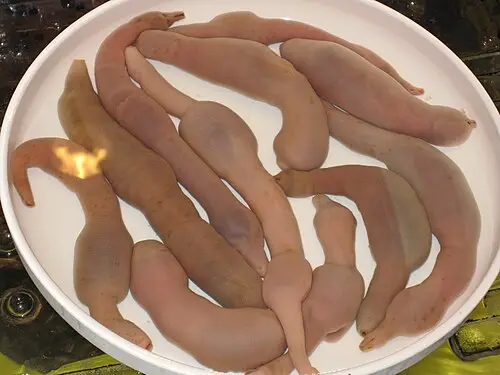
 📸 Photo
Photo: J. Patrick Fischer · CC BY-SA 3.0 · Wikimedia Commons Source
Spoon worm
Urechis unicinctus (Spoon worm · ユムシ)
Not Evaluated (NE) on the IUCN Red List yet.
💡 Everyday Comparisons for Size, Mass & Speed
- 💡 Its length of 15 cm is similar to that of a ballpoint pen (about 14 cm) (Comparison).
- 💡 It is eaten in Korea, China, and Japan and consumed most heavily in Korea. When water temperatures turn cold, boats drag dredges across muddy bottoms to catch it, with large catches along the south coast (National List of Species of Korea).
Reference standards: coach bus ~12 m, mid-size car ~4.9 m, compact car ~1 t, basketball hoop 3.05 m, credit card 8.56 cm.
📖 1. Overview
The spoon worm is an echiuran worm that digs U-shaped burrows in tidal flats and is eaten in Korea, China, and Japan. Worldwide, it is best known in Korea.
🦴 2. Anatomy & Morphology
It has a cylindrical body about 15 cm long whose size changes greatly depending on how much it contracts. Its body color is apricot or reddish milky-white, with small papillae on the skin.
🔍 3. Ecology & Behavior
It digs U-shaped burrows in sandy-mud bottoms from the lower intertidal zone to depths of around 10 m. Sexes are separate, and the breeding season is known to be December–January (or March–April). In summer it retreats more than 1 m deep into its burrow, rising again when water temperatures drop.
🇰🇷 4. Connection to Korea
It is listed on the National List of Species of Korea and is distributed from the central west coast southward—including Taean in Chungcheongnam-do, Dolsando in Jeollanam-do, Geojedo, and Pohang in Gyeongsangbuk-do—as well as along the south coast and the southern East Sea. It is consumed most in Korea, and live spoon worms have recently been imported from China.
📚 Sources & References
- • IUCN Red List: not evaluated (NE) — cross-checked with the Wikidata conservation-status entry
- • marinespecies.org — aphia.php
- • 국가생물종목록(국립생물자원관) ktsn 120000039939 — https://species.nibr.go.kr/home/mainHome.do?cont_link=009&subMenu=009002&contCd=009002&ktsn=120000039939
- • wikidata.org — Q716898
- • commons.wikimedia.org — File:Echiura in Korea1.jpg
- • species.nibr.go.kr — mainHome.do
- • sealifebase.se — Urechis-unicinctus.html
- • Silhouette: PhyloPic — Jun Mencius · CC0 1.0
Recorded dimensions are widely cited representative estimates from public literature and may vary by study or specimen.