 📸 Photo
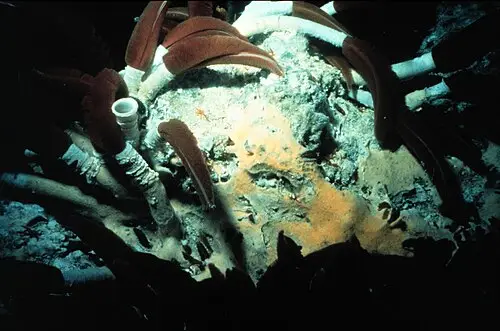
Photo: C. Van Dover (OAR/National Undersea Research Program (NURP); College of William & Mary) · Public domain · Wikimedia Commons Source
Giant tube worm
Riftia pachyptila (Giant tube worm · ガラパゴスハオリムシ)
Not Evaluated (NE) on the IUCN Red List yet.
💡 Everyday Comparisons for Size, Mass & Speed
- 💡 Its tube height of 3 m is 1.5 times the height of a room door (about 2 m) (Comparison).
- 💡 Its maximum weight of 650 g is about 2/3 of a 1 L carton of milk (about 1 kg) (Comparison).
Reference standards: coach bus ~12 m, mid-size car ~4.9 m, compact car ~1 t, basketball hoop 3.05 m, credit card 8.56 cm.
Site-computed relative index from recorded values; not a formal scientific metric.
📖 1. Overview
The giant tube worm is a large tube worm living beside hydrothermal vents on the deep floor of the Pacific Ocean. It has no mouth, eyes, or stomach.
🦴 2. Anatomy & Morphology
Its tough chitin tube grows over 3 m tall, and at the top of the tube is a red plume containing hemoglobin that makes it look like a giant paintbrush. Inside the tube, its body is colorless, and a sac called the trophosome houses billions of symbiotic bacteria.
🔍 3. Ecology & Behavior
Lacking a digestive tract, it relies on symbiotic bacteria that produce nutrients using sulfur compounds from hydrothermal vents. Eggs and sperm meet in the water column, and larvae settle on cooled lava near vents to form new colonies.
🇰🇷 4. Connection to Korea
No direct record connecting this species to Korea has been found.
📚 Sources & References
- • IUCN Red List: not evaluated (NE) — cross-checked with the Wikidata conservation-status entry
- • marinespecies.org — aphia.php
- • wikidata.org — Q133020
- • commons.wikimedia.org — File:Nur04505.jpg
- • sealifebase.se — Riftia-pachyptila.html
- • animaldiversity.org — Riftia pachyptila
- • Silhouette: PhyloPic — author not recorded · CC0 1.0
Recorded dimensions are widely cited representative estimates from public literature and may vary by study or specimen.