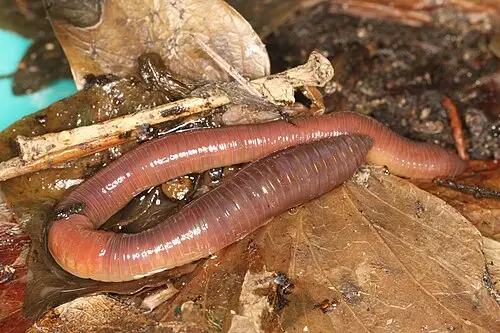
 📸 Photo
Photo: Donald Hobern from Copenhagen, Denmark · CC BY 2.0 · Wikimedia Commons Source
Common earthworm
Lumbricus terrestris (Common earthworm · Common earthworm)
Not Evaluated (NE) on the IUCN Red List yet.
💡 Everyday Comparisons for Size, Mass & Speed
- 💡 Having about 100 earthworms in 1 m² of field soil is considered a sign of good soil (NRCS). An area of 1 m² is about the size of a single yoga mat (about 1.1 m²) (Comparison).
- 💡 Earthworm burrows and castings increase soil pores, helping air and water move through and allowing plant roots to grow deep (NRCS).
Reference standards: coach bus ~12 m, mid-size car ~4.9 m, compact car ~1 t, basketball hoop 3.05 m, credit card 8.56 cm.
📖 1. Overview
The common earthworm (Lumbricus terrestris) is a deep-burrowing earthworm called the night crawler in English. In the United States, it has spread as an introduced species and displaced native earthworms.
🦴 2. Anatomy & Morphology
Because more than 75% of an earthworm's body weight is water, it prefers moist soil to avoid drying out. Its castings, which pass through the body, are rich in nitrogen, phosphorus, potassium, calcium, and microbes.
🔍 3. Ecology & Behavior
It digs long, thick burrows deep in the soil and pulls plant litter from the surface into its burrow to eat. Earthworms are most active in spring and autumn, and in northern forests their numbers can grow so large that the leaf litter layer disappears.
🇰🇷 4. Connection to Korea
No direct record connecting this species to Korea has been found.
📚 Sources & References
- • IUCN Red List: not evaluated (NE) — cross-checked with the Wikidata conservation-status entry
- • catalogueoflife.org — 6R26F
- • wikidata.org — Q30092
- • commons.wikimedia.org — File:Lumbricus terrestris (26559560801).jpg
- • nrcs.usda.gov — Earthworms.pdf
- • Silhouette: PhyloPic — author not recorded · CC0 1.0
Recorded dimensions are widely cited representative estimates from public literature and may vary by study or specimen.