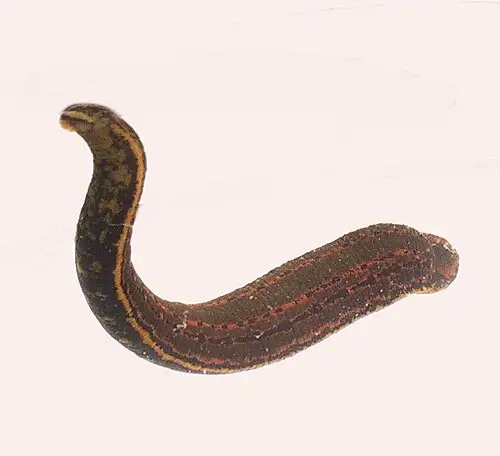
 📸 Photo
Photo: Karl Ragnar Gjertsen Please credit Karl Ragnar Gjertsen This photo was taken by Karl Ragnar Gjertsen . Please credit this photo Karl Ragnar Gjertsen in the imme · CC BY 2.5 · Wikimedia Commons Source
European medicinal leech
Hirudo medicinalis (European medicinal leech · 医療用ヒル)
💡 Everyday Comparisons for Size, Mass & Speed
- 💡 When it takes in 10–15 ml of blood in a single meal, its body swells to 8–11 times its initial size. A volume of 10–15 ml is about one tablespoon (about 15 ml) (ADW diet) (Comparison).
- 💡 In transplant surgeries where blood tends to pool, such as reattaching severed fingers or ears, it is used to relieve pressure and restore blood circulation (ADW positive impacts for humans).
Reference standards: coach bus ~12 m, mid-size car ~4.9 m, compact car ~1 t, basketball hoop 3.05 m, credit card 8.56 cm.
📖 1. Overview
The European medicinal leech lives in freshwater ponds in Europe and is famous for sucking mammal blood and being used in medicine. It is listed as Near Threatened (NT, 2014) on the IUCN Red List.
🦴 2. Anatomy & Morphology
Its cylindrical yet dorsoventrally flattened body is divided into 33–34 segments. The back is dark brown or black with 6 reddish or brown longitudinal stripes, and there is a sucker at both the front and rear ends. The mouth inside the front sucker has teeth, and the head has 5 pairs of eyes.
🔍 3. Ecology & Behavior
When sucking blood from mammals, it injects an anesthetic and an anticoagulant, and a single meal takes about 20–40 minutes. It breeds from June to August, laying an egg sac in damp soil by the water's edge, and young resembling adults hatch after about 14 days.
🇰🇷 4. Connection to Korea
No direct record connecting this species to Korea has been found.
📚 Sources & References
- • IUCN Red List NT (2014) — https://www.iucnredlist.org/species/10190/21415816
- • IUCN Red List category NT — latest assessment at iucnredlist.org
- • checklistbank.org — PT32H
- • iucnredlist.org — 21415816
- • wikidata.org — Q30041
- • commons.wikimedia.org — File:Svømmende blodigle.JPG
- • animaldiversity.org — Hirudo medicinalis
- • sealifebase.se — Hirudo-medicinalis.html
- • Silhouette: PhyloPic — author not recorded · CC0 1.0
Recorded dimensions are widely cited representative estimates from public literature and may vary by study or specimen.