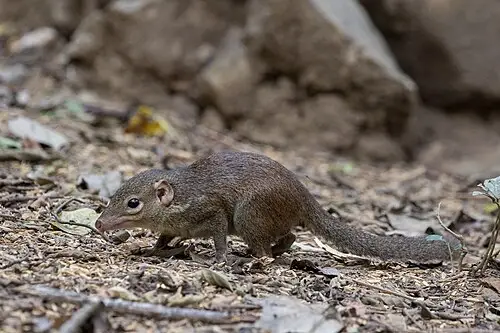
 📸 Photo
Photo: Blair Dudeck · CC BY 4.0 · Wikimedia Commons Source
Northern Treeshrew
Tupaia belangeri (Northern Treeshrew · キタツパイ)
💡 Everyday Comparisons for Size, Mass & Speed
- 💡 Considered a more suitable laboratory animal than mice or rats for studying human diseases, it is used in medical research.
- 💡 Its maximum weight of 200 g is about the weight of one medium-sized apple (Comparison).
Reference standards: coach bus ~12 m, mid-size car ~4.9 m, compact car ~1 t, basketball hoop 3.05 m, credit card 8.56 cm.
Site-computed relative index from recorded values; not a formal scientific metric.
📖 1. Overview
The Northern Treeshrew is a small squirrel-like animal living in the forests of Southeast Asia and southern China.
🦴 2. Anatomy & Morphology
Its back is yellowish brown with light and dark streaks, and its belly is pale yellowish brown. It has a faint stripe on the shoulder, and females have three pairs of nipples.
🔍 3. Ecology & Behavior
It eats a wide variety of invertebrates such as beetles as well as fruits, and is active mainly near the ground during the day. It is monogamous, has a gestation period of 40–52 days, and practices unusual maternal care in which the mother nurses her young only once every about 48 hours.
🇰🇷 4. Connection to Korea
No direct record connecting this species to Korea has been found.
📚 Sources & References
- • IUCN Red List LC (2023) — https://www.iucnredlist.org/species/41492/229775933
- • IUCN Red List category LC — latest assessment at iucnredlist.org
- • mammaldiversity.org — 1000540
- • iucnredlist.org — 229775933
- • wikidata.org — Q378959
- • commons.wikimedia.org — File:Tupaia belangeri 69211397.jpg
- • tb.plazi.org — E75FB01DFA53FFA3BFAF8303FC1C6FAD
- • animaldiversity.org — Tupaia belangeri
- • Silhouette: PhyloPic — author not recorded · CC0 1.0
Recorded dimensions are widely cited representative estimates from public literature and may vary by study or specimen.