 📸 Photo
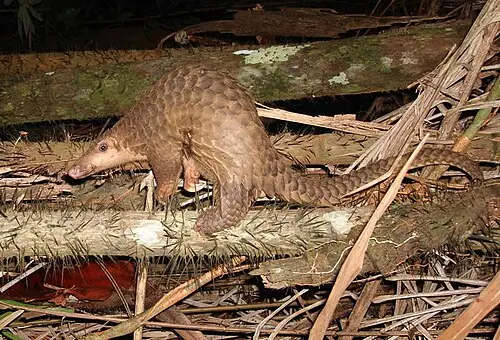
Photo: Piekfrosch at German Wikipedia ( Original text: Piekfrosch (Wikipedia-User) ) · CC BY-SA 3.0 · Wikimedia Commons Source
Sunda Pangolin
Manis javanica (Sunda Pangolin · マレーセンザンコウ)
💡 Everyday Comparisons for Size, Mass & Speed
- 💡 Its total length of 88 cm including the tail is 12 cm short of a 1 m ruler—close to three 30 cm rulers (Comparison).
- 💡 Hunted for its skin, scales, and meat—with its scales traded as medicine—it is now one of the mammals most in need of urgent protection.
Reference standards: coach bus ~12 m, mid-size car ~4.9 m, compact car ~1 t, basketball hoop 3.05 m, credit card 8.56 cm.
📖 1. Overview
The Sunda Pangolin is covered in overlapping scales all over its body, earning it the nickname 'living pinecone.' A specialist that eats only ants and termites, it is listed as Critically Endangered (CR) by the IUCN.
🦴 2. Anatomy & Morphology
Hard scales derived from hair overlap in many rows from just above the nostrils to the tip of the tail, colored olive-brown to yellowish. Its belly and face are covered with white to pale-brown hair, and its skin is grayish to bluish.
🔍 3. Ecology & Behavior
Moving slowly alone at night, it feeds only on ants and termites. It digs burrows with its large claws or uses existing burrows, climbs trees well, and when threatened can run swiftly on its hind legs alone.
🇰🇷 4. Connection to Korea
No direct record connecting this species to Korea has been found.
📚 Sources & References
- • IUCN Red List CR (2019) — https://www.iucnredlist.org/species/12763/123584856
- • IUCN Red List category CR — latest assessment at iucnredlist.org
- • mammaldiversity.org — 1005796
- • iucnredlist.org — 123584856
- • wikidata.org — Q269728
- • commons.wikimedia.org — File:Pangolin borneo.jpg
- • animaldiversity.org — Manis javanica
- • Silhouette: PhyloPic — Steven Traver · CC0 1.0 (Congeneric silhouette — Manis culionensis)
Recorded dimensions are widely cited representative estimates from public literature and may vary by study or specimen.