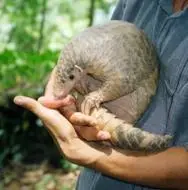
 📸 Photo
Photo: S megan at English Wikipedia · Public domain · Wikimedia Commons Source
Thick-tailed Pangolin
Manis crassicaudata (Thick-tailed Pangolin · インドセンザンコウ)
💡 Everyday Comparisons for Size, Mass & Speed
- 💡 Its highest recorded weight of 20 kg equals a single 20 kg bag of rice, and if scales make up 1/4 of its weight, they weigh about 5 kg at that record size (Comparison).
- 💡 By eating termites, it reduces pests that damage homes and infrastructure, and its meat is considered a delicacy in some places, while illegal trade in its scales for folk medicine and its skin has driven its decline.
Reference standards: coach bus ~12 m, mid-size car ~4.9 m, compact car ~1 t, basketball hoop 3.05 m, credit card 8.56 cm.
Site-computed relative index from recorded values; not a formal scientific metric.
📖 1. Overview
The Thick-tailed Pangolin lives across the Indian region from barren hills to forests and near villages, feeding on ants and termites. It is listed as Endangered (EN) by the IUCN.
🦴 2. Anatomy & Morphology
Yellowish striated scales cover its back and limbs; made of keratin, these scales account for 1/4–1/3 of its body weight, gradually increasing in size and decreasing in number from head to tail.
🔍 3. Ecology & Behavior
Using its sense of smell to find prey, it eats ants and termites—especially favoring their eggs—and also eats beetles. Active at night, it rests during the day in deep burrows, curling into a ball while resting.
🇰🇷 4. Connection to Korea
No direct record connecting this species to Korea has been found.
📚 Sources & References
- • IUCN Red List EN (2019) — https://www.iucnredlist.org/species/12761/123583998
- • IUCN Red List category EN — latest assessment at iucnredlist.org
- • mammaldiversity.org — 1005794
- • iucnredlist.org — 123583998
- • wikidata.org — Q752467
- • commons.wikimedia.org — File:IndianPangolin.jpg
- • animaldiversity.org — Manis crassicaudata
- • Silhouette: PhyloPic — Steven Traver · CC0 1.0 (Congeneric silhouette — Manis culionensis)
Recorded dimensions are widely cited representative estimates from public literature and may vary by study or specimen.