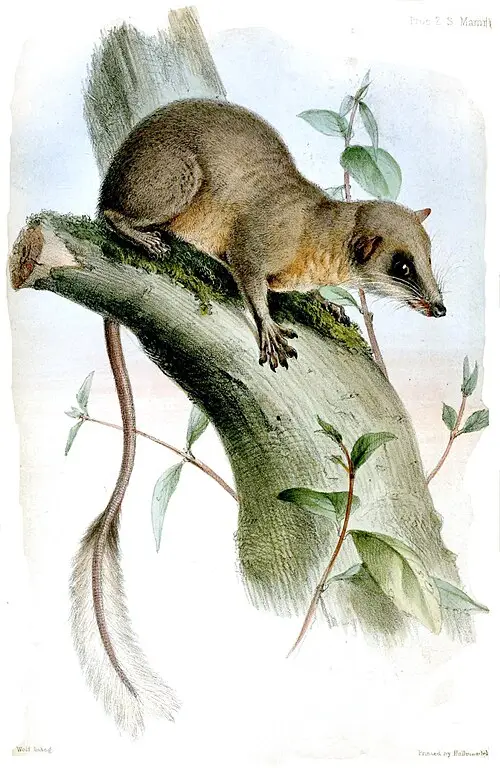
 📸 Photo
Photo: Joseph Wolf (1820 – 1899) · Public domain · Wikimedia Commons Source
Pen-tailed Treeshrew
Ptilocercus lowii (Pen-tailed Treeshrew · ハネオツパイ)
💡 Everyday Comparisons for Size, Mass & Speed
- 💡 Its head-and-body length of 14 cm is the length of a ballpoint pen, and its weight of 62 g is similar to a single egg (Comparison).
- 💡 Although it sometimes appears close to human life in forest-edge houses and rubber plantations, it is said to have no major economic importance.
Reference standards: coach bus ~12 m, mid-size car ~4.9 m, compact car ~1 t, basketball hoop 3.05 m, credit card 8.56 cm.
Site-computed relative index from recorded values; not a formal scientific metric.
📖 1. Overview
The Pen-tailed Treeshrew is the only nocturnal treeshrew species and has a feather-like tuft of hair at the end of its tail. It is sluggish by day and agile at night.
🦴 2. Anatomy & Morphology
Its back is gray to light brown and its belly is white or yellowish. The terminal 2/5 of its tail bears feather-like hairs that are black near the base and fade to white toward the tip, and many individuals have a black mask around the eyes.
🔍 3. Ecology & Behavior
An omnivore, it eats bananas, grapes, crickets, and grasshoppers as well as ants, cockroaches, beetles, and cicadas. It is caught on vines and branches 1.5–2 m above the ground, and nests have been reported on large branches or trunks 12–20 m high, where 2–5 individuals are sometimes found together.
🇰🇷 4. Connection to Korea
No direct record connecting this species to Korea has been found.
📚 Sources & References
- • IUCN Red List LC (2023) — https://www.iucnredlist.org/species/41491/229799507
- • IUCN Red List category LC — latest assessment at iucnredlist.org
- • mammaldiversity.org — 1000536
- • iucnredlist.org — 229799507
- • wikidata.org — Q747125
- • commons.wikimedia.org — File:Ptilocercus lowii.jpg
- • animaldiversity.org — Ptilocercus lowii
- • Silhouette: PhyloPic — T. Michael Keesey (after Joseph Wolf) · CC0 1.0
Recorded dimensions are widely cited representative estimates from public literature and may vary by study or specimen.