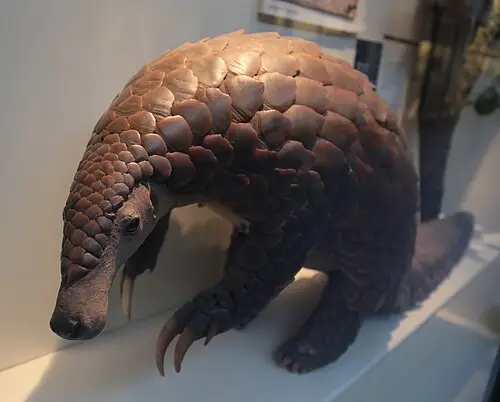
 📸 Photo
Photo: John Cummings · CC BY-SA 3.0 · Wikimedia Commons Source
Giant Pangolin
Smutsia gigantea (Giant Pangolin · オオセンザンコウ)
💡 Everyday Comparisons for Size, Mass & Speed
- 💡 Its average length of 152.4 cm is about the height of an upper-grade elementary school child, and its maximum weight of 35 kg is just under two 20 kg bags of rice (Comparison).
- 💡 In Africa it serves as a source of cheap protein (bushmeat) and income, and its whole body is used in traditional medicine despite no proven efficacy; experts warn that continued overhunting could soon drive it to extinction.
Reference standards: coach bus ~12 m, mid-size car ~4.9 m, compact car ~1 t, basketball hoop 3.05 m, credit card 8.56 cm.
Site-computed relative index from recorded values; not a formal scientific metric.
📖 1. Overview
The Giant Pangolin is the largest and heaviest of all pangolins, living in the forests and savannas of West and Central Africa. It is assessed as Endangered (EN) on the IUCN Red List.
🦴 2. Anatomy & Morphology
Grayish-brown scales usually 10–13 cm long cover its back. Toothless, it has a tongue that can extend up to 70 cm, and its forefeet bear 3 well-developed claws suited for digging.
🔍 3. Ecology & Behavior
At night it digs open underground ant nests and termite mounds to feed, remaining tied to areas where ants and termites are available year-round. When threatened it rolls tightly into a ball; its reproduction is poorly known and it is very difficult to keep in captivity.
🇰🇷 4. Connection to Korea
No direct record connecting this species to Korea has been found.
📚 Sources & References
- • IUCN Red List EN (2019) — https://www.iucnredlist.org/species/12762/123584478
- • IUCN Red List category EN — latest assessment at iucnredlist.org
- • mammaldiversity.org — 1005800
- • iucnredlist.org — 123584478
- • wikidata.org — Q20085878
- • commons.wikimedia.org — File:Giant pangolin (Manis gigantea), Natural History Museum
- • animaldiversity.org — Manis gigantea
- • Silhouette: PhyloPic — T. Michael Keesey · CC0 1.0
Recorded dimensions are widely cited representative estimates from public literature and may vary by study or specimen.