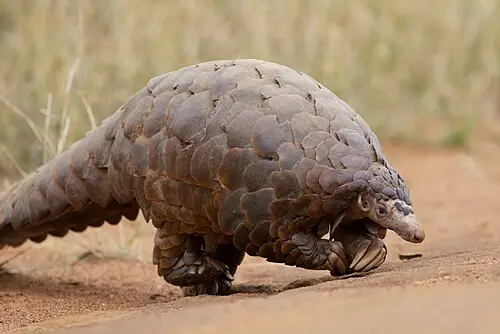
 📸 Photo
Photo: U.S. Fish and Wildlife Service Headquarters · CC BY 2.0 · Wikimedia Commons Source
Ground Pangolin
Smutsia temminckii (Ground Pangolin · サバンナセンザンコウ)
💡 Everyday Comparisons for Size, Mass & Speed
- 💡 Its weight of 18 kg is slightly lighter than a 20 kg bag of rice, and its tongue of up to 25 cm is about 8 tenths of a 30 cm ruler (Comparison).
- 💡 In Africa it is hunted for its scales and meat; the scales are used in ornaments and crafts or exported to China for traditional medicine, while its hide is made into leather goods such as boots and shoes.
Reference standards: coach bus ~12 m, mid-size car ~4.9 m, compact car ~1 t, basketball hoop 3.05 m, credit card 8.56 cm.
Site-computed relative index from recorded values; not a formal scientific metric.
📖 1. Overview
The Ground Pangolin is a pangolin of eastern and southern African woodlands and grasslands whose body is covered in movable, sharp-edged scales. It is assessed as Vulnerable (VU) on the IUCN Red List.
🦴 2. Anatomy & Morphology
Its body is covered in dark olive-brown scales like a pine cone, leaving only the snout tip, chin, throat, sides of the face, and belly unscaled. Toothless, it has a sticky tongue up to 25 cm long and a thick-walled muscular stomach, along with 5 long claws on each foot and a prehensile tail.
🔍 3. Ecology & Behavior
At night it locates termite and ant mounds by scent, tears them open with its foreclaws, and laps up prey with its tongue, swallowing small stones to help grind food in its stomach. When threatened it curls into a tight ball that is hard to pry open; gestation lasts about 139 days and produces a single young.
🇰🇷 4. Connection to Korea
No direct record connecting this species to Korea has been found.
📚 Sources & References
- • IUCN Red List VU (2019) — https://www.iucnredlist.org/species/12765/123585768
- • IUCN Red List category VU — latest assessment at iucnredlist.org
- • mammaldiversity.org — 1005801
- • iucnredlist.org — 123585768
- • wikidata.org — Q28173017
- • commons.wikimedia.org — File:Manis temminckii (29645803646).jpg
- • animaldiversity.org — Manis temminckii
- • Silhouette: PhyloPic — T. Michael Keesey · CC0 1.0 (Congeneric silhouette — Smutsia gigantea)
Recorded dimensions are widely cited representative estimates from public literature and may vary by study or specimen.