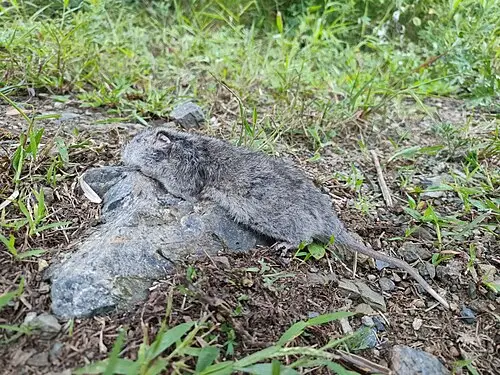
 📸 Photo
Photo: zhangshen · CC BY 4.0 · Wikimedia Commons Source
Common Rat-like Hamster
Tscherskia triton (Common Rat-like Hamster · Common Rat-like Hamster)
💡 Everyday Comparisons for Size, Mass & Speed
- 💡 The 11 mm fur on its back is less than half the diameter of a Korean 500-won coin (about 26.5 mm) (Comparison).
- 💡 It has the habit of living around grain fields such as soybeans, adzuki beans, and mung beans and hoarding food in its burrows (National List of Species of Korea).
Reference standards: coach bus ~12 m, mid-size car ~4.9 m, compact car ~1 t, basketball hoop 3.05 m, credit card 8.56 cm.
📖 1. Overview
The Common Rat-like Hamster is a rodent that digs burrows near soybean, adzuki bean, and mung bean fields, and has also been distributed in Korea.
🦴 2. Anatomy & Morphology
Its fur is fine and soft like wool. The fur on its back is 11 mm long with guard hairs reaching 14 mm; the back is dark gray, the belly is grayish white, and the tail is brown on top and white underneath.
🔍 3. Ecology & Behavior
Because it likes soybeans, adzuki beans, and mung beans, it lives around fields of these crops and digs burrows to store food inside. It breeds twice in 1 year and gives birth to 4–8 young per litter.
🇰🇷 4. Connection to Korea
It is listed in the National List of Species of Korea as "bidanteoljwi" (Korean name). It was distributed in Korea, but has rarely been collected in recent years.
📚 Sources & References
- • IUCN Red List LC (2016) — https://www.iucnredlist.org/species/22432/115166449
- • IUCN Red List category LC — latest assessment at iucnredlist.org
- • mammaldiversity.org — 1002216
- • iucnredlist.org — 115166449
- • 국가생물종목록(국립생물자원관) ktsn 120000053459 — https://species.nibr.go.kr/home/mainHome.do?cont_link=009&subMenu=009002&contCd=009002&ktsn=120000053459
- • wikidata.org — Q937536
- • commons.wikimedia.org — File:Tscherskia triton.jpg
- • species.nibr.go.kr — mainHome.do
- • Silhouette: PhyloPic — Edwin Price · CC0 1.0 (Related taxon silhouette — Oligoryzomys nigripes)
Recorded dimensions are widely cited representative estimates from public literature and may vary by study or specimen.