 📸 Photo
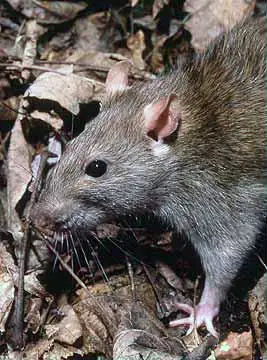
Photo: National Park Service · Public domain · Wikimedia Commons Source
Brown Rat
Rattus norvegicus (Brown Rat · ドブネズミ)
💡 Everyday Comparisons for Size, Mass & Speed
- 💡 Its maximum weight of 500 g is similar to a 500 mL bottle of water, and its combined head-body and tail length of about 40 cm is about a handspan longer than a 30 cm ruler (Comparison).
- 💡 It has been widely used in medical and genetic research and is also popular as a pet (Animal Diversity Web). Almost every port city has this rat.
Reference standards: coach bus ~12 m, mid-size car ~4.9 m, compact car ~1 t, basketball hoop 3.05 m, credit card 8.56 cm.
Site-computed relative index from recorded values; not a formal scientific metric.
📖 1. Overview
The Brown Rat is a large rat that has spread worldwide alongside human settlements and is commonly seen in urban sewers and around buildings.
🦴 2. Anatomy & Morphology
Coarse brown fur covers its back, lightening to pale gray or tan toward the belly. Its ears and tail are hairless, and the tail is shorter than the body. Its eyesight is weak, but its senses of smell, taste, hearing, and touch are highly developed.
🔍 3. Ecology & Behavior
It eats fruits, nuts, beans, and vegetables, and survives on discarded food in cities. Gestation lasts 26 days, and females give birth 4–5 times in 1 year to about 8 young per litter, with a wild lifespan of 1–2 years.
🇰🇷 4. Connection to Korea
It is listed as "Jipjwi" (Korean name) on the National List of Species of Korea and inhabits the entire Korean Peninsula.
📚 Sources & References
- • IUCN Red List LC (2026) — https://www.iucnredlist.org/species/19353/286459858
- • IUCN Red List category LC — latest assessment at iucnredlist.org
- • mammaldiversity.org — 1003649
- • iucnredlist.org — 286459858
- • 국가생물종목록(국립생물자원관) ktsn 120000053470 — https://species.nibr.go.kr/home/mainHome.do?cont_link=009&subMenu=009002&contCd=009002&ktsn=120000053470
- • wikidata.org — Q184224
- • commons.wikimedia.org — File:Rattus norvegicus 1.jpg
- • animaldiversity.org — Rattus norvegicus
- • species.nibr.go.kr — mainHome.do
- • Silhouette: PhyloPic — author not recorded · CC0 1.0
Recorded dimensions are widely cited representative estimates from public literature and may vary by study or specimen.