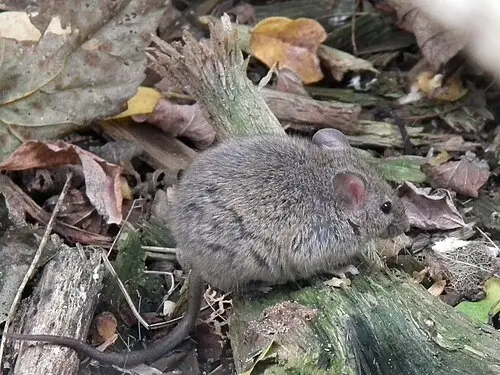
 📸 Photo
Photo: 4028mdk09 · CC BY-SA 3.0 · Wikimedia Commons Source
House Mouse
Mus musculus (House Mouse · ハツカネズミ)
💡 Everyday Comparisons for Size, Mass & Speed
- 💡 A maximum weight of 30 g is about four Korean 500-won coins (about 7.7 g each), and a body length of 10 cm is slightly longer than the long side of a credit card (about 8.6 cm) (Comparison).
- 💡 Laboratory mice were domesticated and bred from this species (National List of Species of Korea), and it is also kept as a pet (Animal Diversity Web).
Reference standards: coach bus ~12 m, mid-size car ~4.9 m, compact car ~1 t, basketball hoop 3.05 m, credit card 8.56 cm.
Site-computed relative index from recorded values; not a formal scientific metric.
📖 1. Overview
The House Mouse is a small rodent that has spread worldwide, living not only in grasslands and croplands but also close to human homes.
🦴 2. Anatomy & Morphology
Its fur is short and soft, ranging from light brown to black on the back with a whitish belly. Its tail is relatively short, its ears are fairly large, and it has 10 nipples.
🔍 3. Ecology & Behavior
In the wild it is an omnivore that mainly eats grass and plant seeds, while near humans it eats almost anything edible. Gestation lasts 19–20 days, females have 6–7 litters a year with 5–6 young per litter, and its lifespan is about 18 months.
🇰🇷 4. Connection to Korea
It is listed as "Saengjwi" (Korean name) in the National List of Species of Korea and occurs throughout the country.
📚 Sources & References
- • IUCN Red List LC (2021) — https://www.iucnredlist.org/species/13972/197519724
- • IUCN Red List category LC — latest assessment at iucnredlist.org
- • mammaldiversity.org — 1003372
- • iucnredlist.org — 197519724
- • 국가생물종목록(국립생물자원관) ktsn 120000053468 — https://species.nibr.go.kr/home/mainHome.do?cont_link=009&subMenu=009002&contCd=009002&ktsn=120000053468
- • wikidata.org — Q83310
- • commons.wikimedia.org — File:Maus außer Haus.JPG
- • species.nibr.go.kr — mainHome.do
- • animaldiversity.org — Mus musculus
- • Silhouette: PhyloPic — Cagri CEVRIM · CC0 1.0
Recorded dimensions are widely cited representative estimates from public literature and may vary by study or specimen.