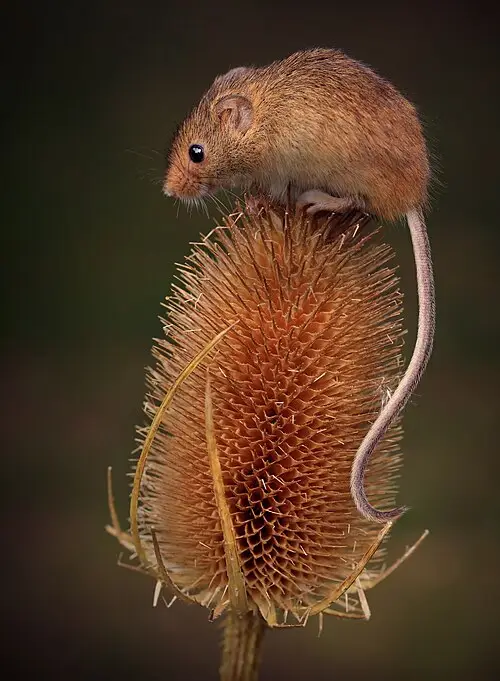
 📸 Photo
Photo: Charlie Marshall · CC BY 2.0 · Wikimedia Commons Source
Eurasian Harvest Mouse
Micromys minutus (Eurasian Harvest Mouse · カヤネズミ)
💡 Everyday Comparisons for Size, Mass & Speed
- 💡 Its average weight of about 6 g is lighter than a Korean 500-won coin (about 7.7 g) (Comparison).
- 💡 In winter they gather in farm granaries and rice sheaves, with thousands recorded in a single spot.
Reference standards: coach bus ~12 m, mid-size car ~4.9 m, compact car ~1 t, basketball hoop 3.05 m, credit card 8.56 cm.
Site-computed relative index from recorded values; not a formal scientific metric.
📖 1. Overview
The Eurasian Harvest Mouse is a tiny mouse living across Eurasia from Spain to Korea that climbs up grass stems.
🦴 2. Anatomy & Morphology
It has large eyes and ears, grasps stems with a bicolored tail that is hairless at the tip, and has a large outer toe that is nearly opposable for gripping.
🔍 3. Ecology & Behavior
It mainly eats grass seeds, adds insects and larvae in summer, and sometimes feeds on stored grain in granaries during winter. It does not hibernate, repeating a cycle of feeding for about 30 minutes and resting for about three hours.
🇰🇷 4. Connection to Korea
It is listed as Met-batjwi (Korean name) on the National List of Species of Korea by the National Institute of Biological Resources (NIBR), and sources include Korea within its distribution range.
📚 Sources & References
- • IUCN Red List LC (2019) — https://www.iucnredlist.org/species/13373/119151882
- • IUCN Red List category LC — latest assessment at iucnredlist.org
- • mammaldiversity.org — 1003576
- • iucnredlist.org — 119151882
- • 국가생물종목록(국립생물자원관) ktsn 120000053466 — https://species.nibr.go.kr/home/mainHome.do?cont_link=009&subMenu=009002&contCd=009002&ktsn=120000053466
- • wikidata.org — Q209516
- • commons.wikimedia.org — File:Micromys minutus - British Wildlife Centre.jpg
- • animaldiversity.org — Micromys minutus
- • species.nibr.go.kr — general-search
- • Silhouette: PhyloPic — An Ignorant Atheist · CC0 1.0 (Related taxon silhouette — Muridae)
Recorded dimensions are widely cited representative estimates from public literature and may vary by study or specimen.