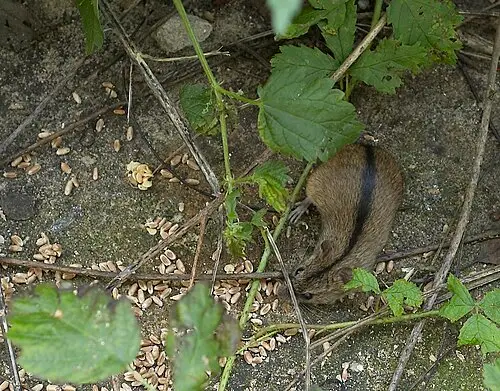
 📸 Photo
Photo: Fibro · CC BY-SA 3.0 · Wikimedia Commons Source
Striped Field Mouse
Apodemus agrarius (Striped Field Mouse · セスジネズミ)
💡 Everyday Comparisons for Size, Mass & Speed
- 💡 Its maximum weight of 38 g is about two-thirds (2/3) the weight of a chicken egg (about 60 g) (Comparison).
- 💡 It damages crops by stealing grain from fields and food from storehouses, and is known as a potential carrier of diseases such as hemorrhagic fever.
Reference standards: coach bus ~12 m, mid-size car ~4.9 m, compact car ~1 t, basketball hoop 3.05 m, credit card 8.56 cm.
Site-computed relative index from recorded values; not a formal scientific metric.
📖 1. Overview
The striped field mouse is a small mouse living in grasslands and farmlands from eastern Europe to East Asia, marked by a black stripe down the center of its back.
🦴 2. Anatomy & Morphology
Its back is yellowish brown with a distinct black stripe running down the middle, and its bicolored tail is about as long as its body. Females have eight nipples.
🔍 3. Ecology & Behavior
An omnivore that eats seeds, shoots, and fruits as well as insects, earthworms, and mollusks, it stays in burrows at night. Capable of breeding year-round, it can produce up to six litters a year.
🇰🇷 4. Connection to Korea
It is listed under the Korean name Deungjuljwi in the National List of Species of Korea (National Institute of Biological Resources (NIBR)), and records note Korea and rice paddies as its habitat.
📚 Sources & References
- • IUCN Red List LC (2016) — https://www.iucnredlist.org/species/1888/115057408
- • IUCN Red List category LC — latest assessment at iucnredlist.org
- • mammaldiversity.org — 1003007
- • iucnredlist.org — 115057408
- • 국가생물종목록(국립생물자원관) ktsn 120000053462 — https://species.nibr.go.kr/home/mainHome.do?cont_link=009&subMenu=009002&contCd=009002&ktsn=120000053462
- • wikidata.org — Q631822
- • commons.wikimedia.org — File:Mysz polna.jpg
- • doi.org — zenodo.6816070
- • animaldiversity.org — Apodemus agrarius
- • species.nibr.go.kr — general-search
- • Silhouette: PhyloPic — Anthony Caravaggi · CC0 1.0 (Congeneric silhouette — Apodemus sylvaticus)
Recorded dimensions are widely cited representative estimates from public literature and may vary by study or specimen.