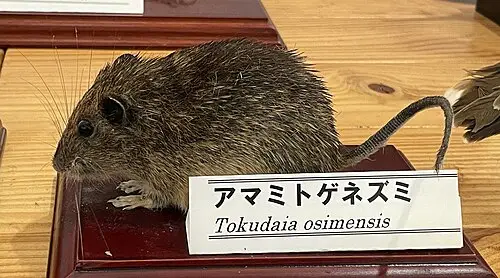
 📸 Photo
Photo: Totti · CC0 · Wikimedia Commons Source
Amami Spiny Rat
Tokudaia osimensis (Amami Spiny Rat · アマミトゲネズミ)
💡 Everyday Comparisons for Size, Mass & Speed
- 💡 Its maximum head-body length of 16 cm is slightly longer than a ballpoint pen (about 14–15 cm) (Comparison).
- 💡 It is also recorded to eat farm crops such as sweet potatoes.
- 💡 Predation by domestic dogs and cats as well as introduced mongooses is cited as a cause of its decline.
Reference standards: coach bus ~12 m, mid-size car ~4.9 m, compact car ~1 t, basketball hoop 3.05 m, credit card 8.56 cm.
📖 1. Overview
The Amami Spiny Rat lives only on Amami Ōshima in Japan and has spine-like hairs mixed into its back fur. Because of its small range and introduced predators such as dogs, cats, and mongooses, it is endangered.
🦴 2. Anatomy & Morphology
Its back is dark orangish-brown and its belly is white to gray, with thick, long fur. Black-tipped spiny hairs (about 20 mm) are mixed in, long hairs around the mouth and eyes reach 30 mm, and the tail is 60–100% of head-body length.
🔍 3. Ecology & Behavior
It is ground-dwelling and appears to be active at night, eating chinquapin nuts, sweet potatoes, ants, and ant larvae. It breeds from October to December (months 10–12) and gives birth to 1–7 young per litter.
🇰🇷 4. Connection to Korea
No direct record connecting this species to Korea has been found.
📚 Sources & References
- • IUCN Red List EN (2016) — https://www.iucnredlist.org/species/21973/22409638
- • IUCN Red List category EN — latest assessment at iucnredlist.org
- • mammaldiversity.org — 1003030
- • iucnredlist.org — 22409638
- • wikidata.org — Q1767684
- • commons.wikimedia.org — File:Tokudaia osimensis 2.jpg
- • zenodo.org — 6868763
- • Silhouette: PhyloPic — An Ignorant Atheist · CC0 1.0 (Related taxon silhouette — Muridae)
Recorded dimensions are widely cited representative estimates from public literature and may vary by study or specimen.