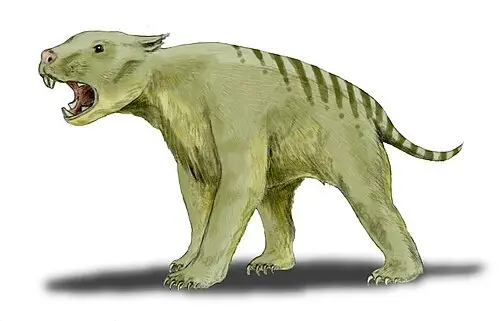
 🎨 Restoration
Restoration: Nobu Tamura ( http://spinops.blogspot.com ) · CC BY 3.0 · Wikimedia Commons Source
Life restorations are artistic reconstructions based on fossil evidence; true coloration and soft-tissue details remain uncertain.
Thylacoleo
Thylacoleo carnifex (Thylacoleo · ティラコレオ)
Known only from fossils. The IUCN Red List assesses only species extant since 1500 CE, so fossil taxa are not assigned a category.
💡 Everyday Comparisons for Size, Mass & Speed
- 💡 Its estimated maximum weight of 160 kg is more than the weight of two adults of around 70 kg each (Comparison).
- 💡 Its body length of 1.5 m is slightly shorter than the arm span of an adult human (about 1.7 m) (Comparison).
- 💡 According to the Australian Museum, its fossils have been found at many sites across Australia, including the Darling Downs in Queensland, Wellington Caves in New South Wales, Naracoorte Caves in South Australia, and caves of the Nullarbor Plain in Western Australia.
Reference standards: coach bus ~12 m, mid-size car ~4.9 m, compact car ~1 t, basketball hoop 3.05 m, credit card 8.56 cm.
Site-computed relative index from recorded values; not a formal scientific metric.
📖 1. Overview
Thylacoleo carnifex (marsupial lion) was the largest known carnivorous marsupial mammal, living in Australia during the Pleistocene. It was the last and largest species of the family Thylacoleonidae.
🦴 2. Anatomy & Morphology
It had blade-like enlarged cheek teeth (third premolars) for slicing flesh, large serrated incisors for stabbing, and a large hooded thumb claw. Its skull was broad with a short snout.
🔍 3. Fossil Record & Paleoecology
It may have hunted large Pleistocene animals such as Diprotodon, ambushing prey or scavenging carrion. Studies indicate that it had the strongest bite force for its size among mammalian predators and could take down prey much larger than itself.
🇰🇷 4. Connection to Korea
No direct record connecting this species to Korea has been found.
📚 Sources & References
- • Fossil taxon — the IUCN Red List assesses only species living or extinct since 1500
- • paleobiodb.org — basicTaxonInfo
- • wikidata.org — Q685786
- • commons.wikimedia.org — File:Thylacoleo BW.jpg
- • australian.museum — thylacoleo-carnifex
- • Silhouette: PhyloPic — Steven Traver · CC0 1.0
Recorded dimensions are widely cited representative estimates from public literature and may vary by study or specimen.