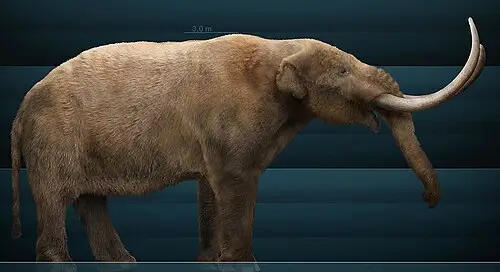
 🎨 Restoration
Restoration: Sergiodlarosa · CC BY-SA 3.0 · Wikimedia Commons Source
Life restorations are artistic reconstructions based on fossil evidence; true coloration and soft-tissue details remain uncertain.
Mammut
Mammut americanum (Mammut · アメリカン・マストドン)
Known only from fossils. The IUCN Red List assesses only species extant since 1500 CE, so fossil taxa are not assigned a category.
💡 Everyday Comparisons for Size, Mass & Speed
- 💡 A male shoulder height of about 3.1 m is roughly 1.8 times the height of a 1.7 m tall adult (Comparison).
- 💡 A maximum weight of about 5.4 tonnes is similar to the weight of 3–4 passenger cars (about 1.5 tonnes each) (Comparison).
- 💡 According to the San Diego Natural History Museum, US President Thomas Jefferson laid out mastodon fossils in the East Room of the White House to examine them in 1808.
Reference standards: coach bus ~12 m, mid-size car ~4.9 m, compact car ~1 t, basketball hoop 3.05 m, credit card 8.56 cm.
Site-computed relative index from recorded values; not a formal scientific metric.
📖 1. Overview
Mammut americanum (American mastodon) was a relative of elephants that lived across North America during the Pleistocene and disappeared about thirteen thousand years ago. It was smaller than a mammoth and had a low, dome-shaped head.
🦴 2. Anatomy & Morphology
Males stood about 3.1 m tall at the shoulder and weighed up to around 6 tonnes, with tusks less curved than those of mammoths but larger and longer than those of modern elephants. Because its molars had cone-shaped cusps, it received a name meaning 'nipple tooth.'
🔍 3. Fossil Record & Paleoecology
It was a herbivore that used its teeth to clip and crush twigs, leaves, and shrubs, feeding mainly on plants from swamps and damp forests. Its tusks are thought to have been used for stripping tree bark or competing for dominance with other individuals.
🇰🇷 4. Connection to Korea
No direct record connecting this species to Korea has been found.
📚 Sources & References
- • Fossil taxon — the IUCN Red List assesses only species living or extinct since 1500
- • paleobiodb.org — basicTaxonInfo
- • wikidata.org — Q378771
- • commons.wikimedia.org — File:AMNH Mastodon.jpg
- • sdnhm.org — mastodon
- • nhmu.utah.edu — mammoths-and-mastodons-made-great-ice-age-team
- • Silhouette: PhyloPic — artrociraptor · CC0 1.0
Recorded dimensions are widely cited representative estimates from public literature and may vary by study or specimen.