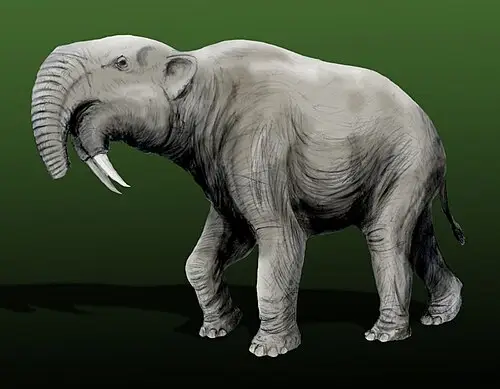
 🎨 Restoration
Restoration: Nobu Tamura ( https://spinops.blogspot.com ) · CC BY 3.0 · Wikimedia Commons Source
Life restorations are artistic reconstructions based on fossil evidence; true coloration and soft-tissue details remain uncertain.
Deinotherium
Deinotherium giganteum (Deinotherium · Deinotherium)
Known only from fossils. The IUCN Red List assesses only species extant since 1500 CE, so fossil taxa are not assigned a category.
💡 Everyday Comparisons for Size, Mass & Speed
- 💡 A shoulder height of about 4 m is well over twice the height of a 1.7 m tall adult human (Comparison).
- 💡 A weight of about 12 tons is similar to the combined weight of about 8 passenger cars (about 1.5 tons each) (Comparison).
- 💡 Research papers report that skeletons of this species have been excavated in the Rostov region of Russia and at Siteia on Crete, Greece.
Reference standards: coach bus ~12 m, mid-size car ~4.9 m, compact car ~1 t, basketball hoop 3.05 m, credit card 8.56 cm.
Site-computed relative index from recorded values; not a formal scientific metric.
📖 1. Overview
Deinotherium giganteum (genus Deinotherium) was an elephant relative that lived during the Miocene; its body shape resembled that of an elephant, but its skull and lower jaw were very different. This species is reconstructed as a huge animal standing about 4 m tall at the shoulder.
🦴 2. Anatomy & Morphology
Adults are reconstructed at about 4 m in shoulder height and about 12 tons in weight, making them about twice as heavy as an African elephant. Because its lower jaw and neck were long, some reconstructions give it a short, tapir-like trunk.
🔍 3. Fossil Record & Paleoecology
Its long shin bones and foot bones suggest that it may have moved slightly more agilely than modern elephants. Its size was estimated from reconstructions based on a nearly complete skeleton.
🇰🇷 4. Connection to Korea
No direct record connecting this species to Korea has been found.
📚 Sources & References
- • Fossil taxon — the IUCN Red List assesses only species living or extinct since 1500
- • paleobiodb.org — basicTaxonInfo
- • wikidata.org — Q20717750
- • commons.wikimedia.org — File:Deinotherium giganteum Kaup - Палеонтологичен музей - А
- • app.pan.pl — app001362014.pdf
- • Silhouette: PhyloPic — Dmitry Bogdanov · CC BY 3.0
Recorded dimensions are widely cited representative estimates from public literature and may vary by study or specimen.